Explore our detailed Lifesum vs MyFitnessPal comparison on features, accuracy, and user experience to find the right nutrition app for your health goals.
The choice between Lifesum and MyFitnessPal really boils down to what you're trying to achieve. There’s no single "best" app—just the one that’s best for you.
If you're the kind of person who lives for data, wants to control every variable, and needs the largest food database possible for performance tracking, MyFitnessPal is the undisputed king. But if your goal is to build healthier habits for the long haul in a more encouraging and beautiful app, then Lifesum offers a much more guided, wellness-focused experience.
Important Disclaimer: This article is for informational purposes only and is not a substitute for professional medical advice. Please consult with a healthcare provider before making any significant changes to your lifestyle, diet, or medication.
Diving into the world of nutrition apps can feel like a lot, but the choice between these two giants often comes down to one question: Are you looking for a powerful, data-heavy tool or a visually engaging, habit-building guide? Both apps want to help you understand what you eat, but they get you there in completely different ways.
Think of MyFitnessPal as a massive, open-source food library. Its biggest strength is its enormous, user-generated database and its ability to connect with almost any fitness device or app you can think of. This makes it the default choice for anyone who needs to track very specific or obscure foods. It’s built for precision.
Lifesum, on the other hand, feels more like a personal wellness journal. It’s polished, thoughtfully designed, and packed with curated recipes. It focuses on teaching you about the quality of your food, not just the raw numbers, which is great for fostering a healthier relationship with eating over time.
When you’re weighing your options, it can be helpful to see how other services are judged. For example, looking at a detailed BistroMD vs Nutrisystem comparison can give you a good framework for what to look for, even when you're just picking an app.
Sometimes, seeing it all laid out makes the decision easier. Here’s a quick snapshot of what each app brings to the table and who it’s really built for.
Ultimately, this all comes back to aligning the app with your own health goals and personal style.
Both of these apps are fantastic, but they aren't the only options out there. If you're exploring other platforms that take a different approach, you can check out our comparison between Cal AI vs Lifesum for another perspective.
The heart of any nutrition app is its food database. It's where you'll spend most of your time, and when we look at Lifesum vs MyFitnessPal, their core philosophies on data create two very different experiences.
MyFitnessPal is built on a simple principle: sheer scale. Its database is massive, cobbled together from millions of user contributions from all over the world. This is its biggest strength and, honestly, its most significant weakness.
If you eat a wide variety of foods—hitting up local restaurants, trying international products, or making complex recipes from scratch—MyFitnessPal’s database is hard to beat. The odds of finding exactly what you’re looking for, whether it’s a niche protein powder or a specific dish from your favorite cafe, are incredibly high.

But here's the catch with that crowdsourced model: the accuracy can be all over the place. Since anyone can add an item, you’ll often find yourself staring at multiple entries for the exact same product, each with conflicting nutritional info. You have to be discerning and watch out for funky serving sizes or calorie counts.
Lifesum takes the opposite road, choosing quality over quantity. Its database is much smaller, but it’s carefully curated and verified by their own team of nutrition experts. This means when you log something in Lifesum, you can generally trust the data is spot-on.
This curated approach feels less frustrating and more educational, especially if you're just starting out. Instead of sifting through a dozen duplicate entries for "scrambled eggs," you get a clean, reliable option. Lifesum also has a food rating system that helps you understand the quality of your choices, not just the raw numbers.
For someone focused on heart health, this distinction is crucial. You need to accurately track things like sodium, saturated fat—a type of fat that can raise LDL cholesterol (the "bad" kind)—and fiber to manage cardiovascular risks. Lifesum’s verified data gives you much more confidence in those specific, critical metrics.
The trade-off, of course, is that you might not always find what you're looking for. A smaller database is less likely to have that obscure brand or hyper-specific restaurant meal, which can make logging a bit of a pain if your diet is really varied.
So, what do these different approaches actually feel like day-to-day? Let's break it down.
When it comes to pure volume, MyFitnessPal’s library of roughly 14 million items completely dwarfs Lifesum's 350,000. This gives it a massive advantage in global markets with diverse cuisines. As we noted in our review of top calorie apps, MyFitnessPal's huge database makes it a popular choice for beginners. For a deeper look at how it stacks up against other trackers, check out MyFitnessPal in our Cal AI comparison.
In short, MyFitnessPal offers a massive, user-generated database that prioritizes quantity, while Lifesum provides a smaller, professionally verified database that prioritizes accuracy and trust.
An app's design is more than just how it looks—it's about how it feels to use every single day. That feeling is a huge factor in whether you stick with your health goals or get frustrated and quit. This is where the Lifesum vs. MyFitnessPal comparison reveals two completely different philosophies.
Lifesum goes for a polished, almost serene, and visually engaging experience. Opening the app feels like cracking open a wellness journal. It’s all clean lines, vibrant colors, and intuitive navigation that gently guides you instead of overwhelming you. The design feels crafted to make tracking an encouraging, mindful part of your day.
MyFitnessPal, on the other hand, is all about function over form. It’s a data-rich, utilitarian workhorse designed to throw a massive amount of information at you quickly. For anyone who wants to see every metric at a glance and values comprehensive data above all else, this no-nonsense approach is incredibly effective.

Let’s get into the most common task you’ll do: logging a meal. This is where the differences in user experience really jump out.
Logging on Lifesum is a smooth, visually guided process. Adding your food feels less like a chore and more like a simple, satisfying check-in. The app uses bright icons and a super clean layout, making it easy for beginners to find what they need without getting lost in endless menus.
MyFitnessPal’s logging process is built for raw speed and efficiency, especially for power users. It can definitely feel cluttered with text and numbers, but its "quick add" features and massive list of recent foods let experienced trackers log entire meals in just a few seconds. The focus is purely on getting the data in as fast as humanly possible.
"I found Lifesum's interface much more calming. Logging my meals felt positive, which kept me coming back. MyFitnessPal was powerful, but it felt like I was filling out a spreadsheet for every meal, which became draining over time." - A user perspective from a community health forum.
This isn't just about personal preference; usability research backs up these different experiences. A 2019 study published in JMIR mHealth and uHealth, a peer-reviewed journal found on PubMed, used the System Usability Scale (SUS) to evaluate seven diet-tracking apps.
In that study, Lifesum earned a standout SUS score of 89.2 out of 100, placing it in the top tier for user-friendliness among the apps tested. That high score is an objective reflection of its polished design and intuitive interface that people find easy to learn and navigate. You can learn more about these usability findings directly from the study. MyFitnessPal, while functionally a beast, did not score as high in this particular study on these specific ease-of-use metrics.
So, which interface is "better"? It honestly depends entirely on your personality and what you're trying to achieve.
Ultimately, the best interface is the one you’ll actually use consistently. For many people, especially those focused on building sustainable, heart-healthy habits, an encouraging and straightforward experience like Lifesum’s can make all the difference. That approach lines up perfectly with habit-focused platforms like HeartFit (heartfit.ai), where a positive user journey is everything.
While tracking calories and macros is the starting line for both apps, the real differences in the Lifesum vs MyFitnessPal showdown pop up when you look at everything else built around that core feature. Each app has its own ecosystem designed for different motivations, moving well past simple data entry.
MyFitnessPal plays to the strength of its massive user base, creating a powerful social experience. The whole platform is built on the idea that accountability and sharing what you know are huge motivators. Honestly, this community aspect is one of its biggest selling points.
Lifesum, on the other hand, is all about personalized guidance and structured wellness. It feels more like a personal health coach in your pocket, giving you tools and plans to build lasting habits in a more private, self-guided way.
MyFitnessPal's community is, without a doubt, its superpower. The app has active forums buzzing with people asking questions, sharing success stories, and finding support from others on the same path. That kind of peer-to-peer connection can be a game-changer for staying motivated.
It also has features for adding friends, joining group challenges, and sharing progress updates, which creates a natural accountability loop right inside the app.
MyFitnessPal's enormous community, rated 5 out of 5 by some fitness experts for its forums and groups, fosters motivation through social sharing and challenges. The platform's vast recipe library further enhances this ecosystem, making it a hub for user-generated content and support. Find out more about how these apps handle your data and why it's important to be mindful of your digital privacy.
Lifesum deliberately takes a different approach. It has very limited community features because it’s designed to prioritize your individual journey over social sharing. The whole experience feels much more personal and introspective.
This is where Lifesum really steps up. The app is loaded with tools designed not just to track what you eat, but to actually teach and guide you toward healthier habits.
One of Lifesum’s standout features is its "Life Score." This is a unique metric that assesses your eating and exercise habits through a short quiz to give you a single health rating. It's meant to give you a big-picture view of your lifestyle and show you where you can improve, turning the simple act of tracking into a learning experience. For a closer look, our comprehensive Lifesum app review dives into these features in much more detail.
When it comes to logging physical progress, MyFitnessPal offers a lot more depth. You can track your weight, of course, but also a whole range of body measurements like your waist, hips, and neck. The ability to upload progress photos is a really powerful visual tool for seeing how your body composition is changing.
Both apps let you customize your macro goals, but MyFitnessPal's premium version gives you finer control. For example, you can set different goals for different days, like higher carbs on training days and lower on rest days. This level of detail is perfect for athletes or anyone with very specific fitness targets.
In the end, it really comes down to what drives you. If you get a boost from community support and want detailed logs of your physical progress, MyFitnessPal is the clear winner. But if you'd rather have structured guidance, educational insights, and tools that help you build new habits, Lifesum provides a more supportive and holistic environment.
Deciding between Lifesum and MyFitnessPal often comes down to a simple question: should I pay for this? Both apps give you a pretty solid free experience, but the features they stash behind a paywall really tell you who each app is for.
The free versions cover the basics you'd expect. You can log your meals, keep an eye on your main macros (protein, carbs, fat), and scan barcodes to make life easier. Right away, though, you'll notice a difference. MyFitnessPal’s free tier is famously crowded with ads, which can be a real drag on the user experience. Lifesum feels much cleaner, but it teases you with its best educational content, like specific diet plans and detailed nutrient insights, which are locked away in the premium version.
For a lot of people just starting out, the free plan is more than enough to build some basic awareness. But if you're serious about your goals, you'll probably find yourself eyeing that upgrade button sooner or later.
MyFitnessPal Premium is built for people who live and breathe data. If you want granular control and deep-dive analytics on your nutrition, this is where you'll want to be. The subscription will set you back $19.99 per month or $79.99 for the year.
Here’s what that gets you:
The real value here is precision. If you’re an athlete, working closely with a nutritionist, or need to monitor specific micronutrients for a health condition, the cost can be justified by the sheer amount of data you get.
MyFitnessPal Premium isn’t just a food diary; it's a powerful analytical tool. The ability to track food timestamps and dive into detailed nutrient dashboards provides the kind of data that’s indispensable for anyone serious about performance or health management.
Lifesum Premium takes a completely different approach. It’s more affordable, at $9.99 per month or $49.99 per year, and it focuses on guidance, education, and building healthy habits—not just crunching numbers.
A Lifesum subscription unlocks:
Think of Lifesum Premium as a wellness coach in your pocket. It's a fantastic fit for beginners who feel overwhelmed and need structure, or for anyone who wants inspiration to build a healthier lifestyle without getting lost in data. This approach is a natural fit for programs like HeartFit that prioritize making sustainable, long-term changes.
So, who wins on value? It completely depends on what you're trying to achieve. If you need meticulous data analysis, MyFitnessPal Premium is the undisputed champ. But for guided wellness and practical, supportive tools at a lower cost, Lifesum Premium is the way to go.
To make it even clearer, let's break down what's free and what's behind the paywall for each app. As you'll see, the free versions are functional, but the premium tiers are where the true power of each app is unlocked.
This table really highlights the philosophical difference between the two. MyFitnessPal locks its deep data tools behind Premium, while Lifesum reserves its educational content, recipes, and diet plans for paying members. Your personal goals will make it obvious which "upgrade" is the right one for you.
Alright, let's get down to it. Choosing between Lifesum and MyFitnessPal really boils down to your personal health philosophy and what you actually need the app to do for you. They both track food, but they couldn't be more different in their approach. Each one excels in its own way, catering to very different people and goals.
This little decision tree can help you figure out which path makes the most sense for you—are you after total data control, or are you looking for a more guided wellness journey?
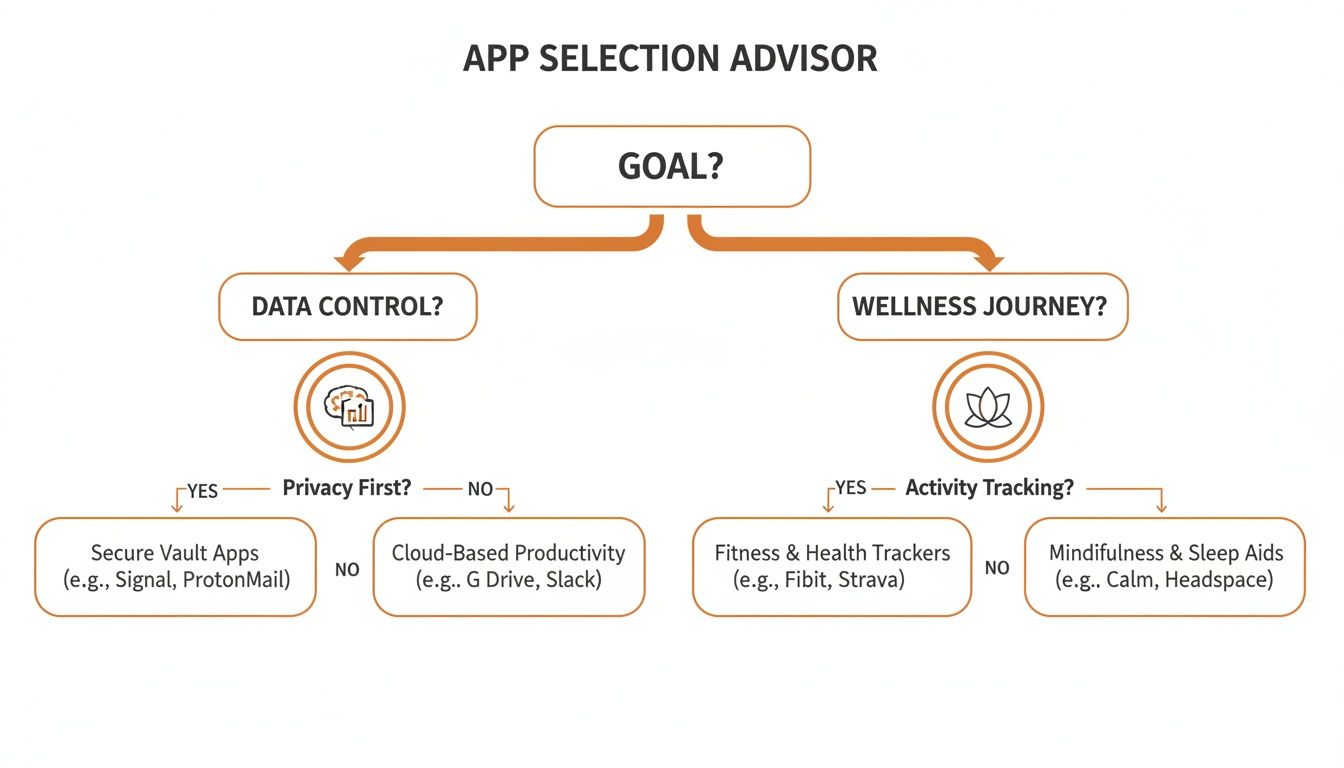
As you can see, the single biggest factor is your primary goal. Once you know that, the choice becomes much clearer.
If you're an athlete, a seasoned nutrition tracker, or just someone who loves getting into the weeds with data, MyFitnessPal is your tool. Hands down. Its massive, user-generated food database is simply unmatched, which is a lifesaver when you’re logging meals from restaurants or while traveling abroad.
The app's strength is its no-nonsense, function-first design. If you want to meticulously manage your macros down to the gram, set different goals for training days versus rest days, and pour over detailed progress reports, MyFitnessPal delivers a level of precision that Lifesum just can't touch. Think of it as a powerful analytics engine for people who are comfortable with numbers and prioritize comprehensive tracking over a pretty interface.
On the other hand, if you're new to all this or your main goal is building sustainable, healthy habits in a more supportive space, Lifesum is the way to go. Its polished, intuitive interface makes the daily chore of logging feel encouraging rather than like a clinical task.
Lifesum is more focused on food quality, guided meal plans, and habit trackers for things like water intake. It’s built not just to count calories, but to actually educate and inspire a healthier relationship with food.
It's an approach that pairs perfectly with planning ahead. For those serious about nutrition, having practical food storage for meal prepping can make a huge difference in staying on track, and Lifesum’s structured vibe really supports that routine.
When your main focus is cardiovascular wellness, neither of these apps is a complete solution on its own. They're fantastic data collectors, but you'll get the best results by pairing them with a platform designed specifically for heart health. A list of heart healthy tracking apps to consider includes:
Ultimately, both Lifesum and MyFitnessPal can work as companion apps in a heart-health strategy, feeding their detailed dietary data into a central hub to give you and your care team a more complete picture of your health.
When you're trying to pick between Lifesum vs. MyFitnessPal, a few common questions always seem to pop up. Let's get you some straight answers so you can make the right call for your own health goals.
If your main goal is drilling down into the specific nutrients that affect heart health—like sodium, fiber, and saturated fats—MyFitnessPal Premium has a slight advantage. Its detailed tracking is incredibly useful if you're following strict guidance from your doctor. For instance, the American Heart Association recommends specific sodium limits for many individuals, and MyFitnessPal makes it easier to monitor those targets.
But for a dedicated approach to cardiovascular wellness, you may want a specialized tool. Think of it this way:
The short answer is no, unfortunately. There's no direct way to move your data from Lifesum to MyFitnessPal, or vice versa. If you decide to make a switch, you’re essentially starting fresh with a blank slate.
This means you have a choice to make. What's more important to you right now: your logged history or the features of the other app? While you can often export your data as a CSV file for your own records, you can't just upload that file into the competitor's app.
This is where both apps really shine. Lifesum and MyFitnessPal were built to play nicely within a bigger health ecosystem. They both sync up smoothly with the major players like Apple Health and Google Fit, which is a huge plus.
This integration lets them be the single source of truth for your nutrition. For example, you can log a meal in MyFitnessPal, and that data automatically flows into a specialized platform like HeartFit through its connection with Apple Health. It's a smart way to get a complete, holistic view of your health by combining detailed diet tracking with targeted heart monitoring, all without having to enter the same meal twice.
LDL cholesterol stands for low-density lipoprotein. It is often referred to as the "bad" cholesterol because high levels can lead to the buildup of plaque in your arteries, a condition known as atherosclerosis. Managing LDL is a key part of maintaining heart health. You can learn more from authoritative sources like the Centers for Disease Control and Prevention (CDC).
Disclaimer: This article is for informational purposes only and is not a substitute for professional medical advice, diagnosis, or treatment. Always seek the advice of your physician or other qualified health provider with any questions you may have regarding a medical condition. Please consult with a healthcare provider before making any changes to your diet, lifestyle, or medication.
Take control of your cardiovascular wellness with a system designed for lasting change. HeartFit turns your health plan into simple, daily habits you can actually stick with. Start your free 7-day trial at HeartFit.ai and build a healthier future.
Download HeartFit.ai and start your 66-day journey today.



Join the #hearthealth crowd who are leveling up their heart health with HeartFit.ai