A detailed Cal AI vs Lifesum comparison. Discover which AI nutrition tracker is best for your food logging accuracy, health goals, and lifestyle.

Picking between Cal AI and Lifesum really comes down to what you’re trying to accomplish. Cal AI is all about speed and simplicity, leveraging its AI camera to get your meals logged fast. On the other hand, Lifesum plays the long game, focusing on building healthy habits through structured meal plans and guidance.
Disclaimer: This article is for informational purposes only and is not a substitute for professional medical advice. Always consult with a healthcare provider before making significant lifestyle or medication changes.
Choosing the right app is a huge first step. While both Cal AI and Lifesum are powerful, they come from completely different philosophies. One is built for the user who wants quick data entry and trusts AI to do the heavy lifting, while the other is for someone looking for more hands-on guidance and education.
Cal AI is a newer app designed to tackle the single biggest headache of food logging: the time it takes. It’s seriously impressive, capable of identifying your meal’s calories and macros from a photo in under 15 seconds with about 90% accuracy. For anyone who’s ever given up on tracking because it’s too tedious, this is a game-changer.
Lifesum, a well-established player in the space, offers a much more comprehensive experience. It’s an entire ecosystem that includes:
This simple flowchart nails the core decision you need to make.
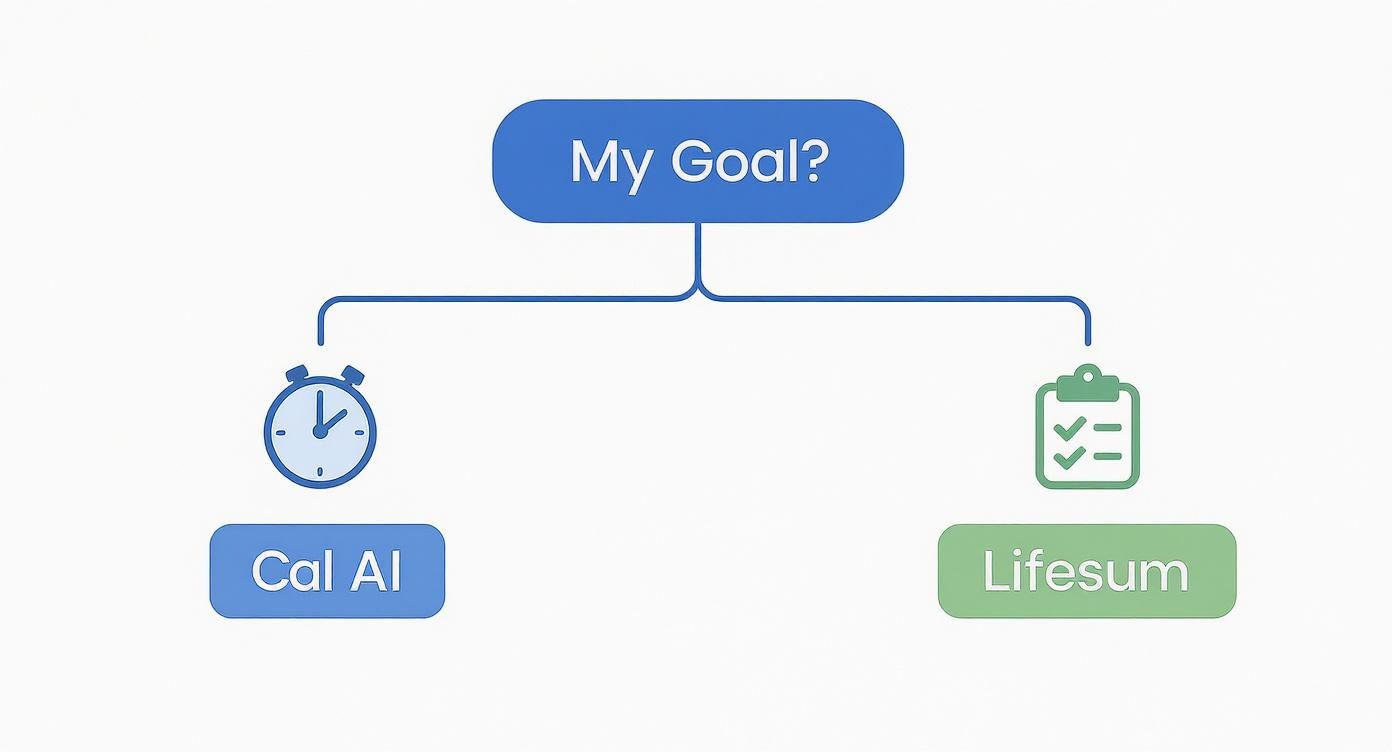
As you can see, it boils down to whether you value speed and efficiency over structured support. Understanding this difference is key before digging into the nitty-gritty features. While both apps get the job done, they are far from interchangeable. If you're exploring other options, our guide on the best health tracking apps is a great place to start.
To make things even clearer, here's a quick side-by-side look at what defines each app. This should give you a gut feeling for which one aligns better with your personality and goals.
Ultimately, this table highlights the fundamental divide: Cal AI is a tool for rapid data collection, whereas Lifesum is more of a lifestyle coach in your pocket. Your choice depends entirely on which of those you need more right now.
The core of any nutrition app is how fast and accurately you can log what you eat. Get this wrong, and the whole habit falls apart. This is where Cal AI and Lifesum take two completely different paths, and your personal preference will almost certainly decide which one earns a permanent spot on your phone.

Cal AI is built from the ground up for one thing: speed. Its entire experience revolves around an AI-powered photo scanner, designed to kill the tedious manual entry that makes most people quit tracking. Just snap a picture of your plate, and the app identifies the food, estimates the portions, and gives you the nutritional stats.
In the real world, Cal AI’s photo logging is impressively quick. For simple, single-item foods—think an apple, a bowl of oatmeal, or a piece of grilled chicken—it’s usually spot-on. Where it gets a little trickier is with complex, multi-ingredient meals. A homemade stew or a big mixed salad with overlapping ingredients can sometimes challenge the AI's accuracy.
Here’s where Cal AI really shines:
That said, this technology is improving rapidly. A 2022 study published in Nutrients found that AI-based dietary assessment methods are becoming increasingly accurate, with some models achieving high precision in food recognition. While this specific study didn't include the newer Cal AI, the trend is clear: AI is closing the gap on manual logging.
On the other hand, Lifesum sticks to a more traditional—but incredibly powerful—set of tools. It gives you multiple ways to log your food, offering total flexibility at the cost of a bit more manual effort.
Key Takeaway: Lifesum gives you absolute control and precision through its massive, verified database. Cal AI offers unmatched speed with its photo scanning. Your choice comes down to what you value more: granular accuracy or effortless consistency.
Lifesum's logging methods include:
This approach is tailor-made for people who cook at home a lot or simply want total control over their data. Scanning a protein bar is instant and flawless. Logging a homemade soup, however, means you have to enter each ingredient the first time you make it. For another look at how AI-first apps stack up against the classics, our Cal AI vs MyFitnessPal breakdown offers a different perspective.
In short, your choice between Cal AI and Lifesum for food logging comes down to your tracking style. If speed is everything and you're fine with AI-driven estimates to keep you on track, Cal AI is the clear winner. But if you demand precision and don't mind a more hands-on approach for complete data control, Lifesum’s robust system is built for you.

Any decent nutrition app can track calories. The great ones, however, do so much more. They build a whole ecosystem around your goals, integrating different parts of your lifestyle into a cohesive health plan.
When you look closely at Cal AI vs Lifesum, you see two very different philosophies at play. One is all about guided habit formation, giving you a clear roadmap to follow. The other is built for data-driven optimization, offering sharp insights to help you fine-tune your own approach.
Think of Lifesum less as a tracker and more as a lifestyle coach in your pocket. It’s built on a comprehensive framework that supports your health from every angle, making it fantastic for anyone who wants a clear, structured path.
This whole ecosystem is perfect if you’re feeling a bit overwhelmed and just need clear, reliable direction to get started and stay on track.
Cal AI takes a completely different route. It’s built for the user who wants to understand their own patterns and make informed decisions, rather than follow a preset plan. The entire experience is centered on delivering sharp, actionable insights from the data you log.
For many people, the goal is to understand how to calculate macros accurately for their specific body and fitness targets, and Cal AI’s data-first approach is tailor-made for this.
Its core features are all about AI-powered analysis:
This approach is best for the data-driven user who wants to tweak and optimize their nutrition based on personalized feedback and their own analysis.
While both apps share the goal of improving your health, their toolkits are designed for different kinds of users. The table below highlights the unique features that define each app's approach, going beyond simple calorie tracking to show you where their true strengths lie.
In short, Lifesum offers a holistic, guided experience perfect for those who want a clear path laid out for them. Cal AI, on the other hand, empowers users who prefer to dig into their own data, uncover patterns, and chart their own course with the help of smart, AI-driven feedback.
When you’re trying to manage a specific health condition, a generic nutrition app often falls short. It’s no longer just about counting calories; the game shifts to tracking the very specific nutrients that can make or break your health goals. Looking at Cal AI vs Lifesum through this lens, some important differences pop up right away.
Lifesum has a clear upper hand for anyone who thrives on structure. It comes loaded with dedicated meal plans, including the Mediterranean diet, which is widely praised by groups like the American Heart Association for its cardiovascular benefits. According to the AHA, this dietary pattern can help lower the risk of heart disease and stroke. With Lifesum, you can zero in on key heart-health metrics like sodium, fiber, and saturated fats, giving you a straightforward way to see how you’re stacking up against your targets.
Cal AI takes a different path. It doesn't offer any pre-packaged diet plans. Instead, its power is in its AI-driven analysis, which excels at spotting patterns and giving you feedback on the overall quality of your meals. While you can definitely monitor specific nutrients, it’s a much more self-directed experience. You have to know your own targets, and the AI acts as your partner in figuring out how well your food choices are hitting them.
When cardiovascular health is your number one priority, a specialized tool is almost always going to serve you better. General nutrition apps are great, but platforms built from the ground up for heart health understand the small details that matter most.
Here are the best tracking apps specifically for heart health:
Here’s a look at the HeartFit dashboard, which is all about daily, actionable habits.
.png)
The whole interface is designed around checking off small, manageable tasks that build up to significant long-term heart health improvements. If you want to dive deeper into how different apps handle food logging, check out our guide to the best health food scanner apps.
Q: What is a normal resting heart rate?
A: According to the Mayo Clinic, a normal resting heart rate for most adults ranges from 60 to 100 beats per minute.
Q: What is LDL cholesterol?
A: LDL (low-density lipoprotein) cholesterol is often called the "bad" cholesterol. The Centers for Disease Control and Prevention (CDC) explains that high levels of LDL can lead to plaque buildup in your arteries, increasing your risk for heart disease and stroke.
Ultimately, for anyone serious about their cardiovascular health, the best approach is often using a specialized app like HeartFit as your foundation. From there, either Cal AI or Lifesum can serve as a powerful secondary tool to handle the detailed nutritional data logging.

An app's amazing features don't mean a thing if it's a pain to use or if it plays fast and loose with your privacy. Daily usability is a huge deal in the Cal AI vs. Lifesum matchup, and the two apps couldn't be more different.
Cal AI is all about minimalism. The interface is clean, uncluttered, and built for one thing: AI photo logging. This laser focus makes tracking your meals incredibly fast. It’s perfect if you just want to get in, log your food, and get on with your day.
Lifesum, on the other hand, gives you a dashboard packed with features. You'll find meal plans, recipe ideas, and little bits of educational content everywhere. For someone looking for a lot of guidance, this is fantastic. But if you just want a simple tracker, it can feel a bit crowded.
Let's be clear: when you're logging meals and health stats, you're handing over some very sensitive information. It’s critical to know what’s happening with that data. Both Cal AI and Lifesum say they use your info to improve their services, but the devil is in the details of their policies.
It’s just smart practice to be aware of the data privacy practices in health apps before you start logging. Always take a few minutes to actually read the privacy policy before you commit your personal health data to any app.
Key Consideration: Your health data is intensely personal. Before you go any further, skim each app’s privacy policy. Make sure you’re comfortable with how they plan to collect, store, and use your information.
A nutrition app gets a lot more powerful when it talks to the other health tools you use. The good news is that both Cal AI and Lifesum play nicely with the big health platforms, creating a single, synced-up view of your health.
This connectivity means that no matter which you choose—Cal AI's speed or Lifesum’s guided approach—it will slot right into your existing health stack.
Let's talk about the bottom line: what’s this going to cost you? Both Cal AI and Lifesum run on a "freemium" model. You can get started with either for free, but the real power of each app is locked behind a paid subscription.
Cal AI's free version is surprisingly capable, letting you use its star feature—the AI photo logging. This is a great way to test the waters. But to get the deeper analysis, the macronutrient details, and the personalized feedback on your eating habits, you'll need to open your wallet.
Lifesum also offers a free tier for basic calorie counting. However, all the features that make Lifesum Lifesum—the structured meal plans, huge recipe database, and support for specific diets—are part of the premium package. Honestly, the free version feels more like a trial than a long-term solution.
When you look at the price tag, remember that paying annually almost always saves you a good chunk of change compared to a monthly subscription.
So, which one offers better value? That really comes down to what you’re paying for.
Value Proposition: With Cal AI, you're paying for speed and sophisticated AI analysis; it's all about efficiency and data. With Lifesum, you're paying for a massive library of structured content, from meal plans to recipes; it's about guidance and education.
If you thrive with a clear roadmap and want someone to tell you what to eat, Lifesum is a solid investment. But if you're a tech-focused user who values saving time and wants AI to help optimize your choices, Cal AI's subscription will feel well worth the cost. It all comes back to your personal style and what you need from a health app.
Alright, let's cut to the chase. The right app for you really boils down to your personality and what you're trying to achieve. Are you looking for speed and smart data, or do you prefer a more guided, educational path to your health goals? Each app has a distinct flavor and caters to a different kind of person.
Cal AI is hands-down the winner for anyone who just wants to get things done. If your biggest hurdle is the time it takes to log your food and you just want fast, AI-driven feedback to tweak your diet, this app was made for you. It's perfect for the person who is comfortable with technology, wants to be consistent, and trusts data to point them in the right direction.
On the other hand, Lifesum is the go-to if you thrive on structure and clear guidance. It’s packed with meal plans, including some backed by big names like the American Heart Association, giving you a real roadmap to follow. This makes it a fantastic choice for beginners or anyone who wants a supportive, almost coach-like experience to build better habits from the ground up.
Now, if your main focus is improving your heart health, a general-purpose nutrition tracker may not be enough. They're great tools, but you'll get more mileage from a specialized app designed for cardiovascular wellness.
Our Takeaway: For the best results, use a dedicated heart health app as your home base and a nutrition tracker as its powerful sidekick. This gives you the best of both worlds—targeted guidance for your heart and granular data on your diet.
Here's how to build the ultimate heart-healthy app stack:
Disclaimer: This article is for informational purposes only and does not constitute medical advice. Please consult with a registered dietitian or healthcare provider before making any significant changes to your diet or lifestyle.
Ready to build lasting habits for a healthier heart? Heart Fit turns your action plan into a simple, motivating daily system. Start your free trial and see how easy it can be to take control of your cardiovascular wellness. Visit https://www.heartfit.ai to begin.
Download HeartFit.ai and start your 66-day journey today.



Join the #hearthealth crowd who are leveling up their heart health with HeartFit.ai