Cal AI vs myfitnesspal showdown: cal ai vs myfitnesspal - compare AI coaching, logging accuracy, features, and cost to choose your fit.
Choosing a nutrition app in today's crowded market can feel overwhelming. The decision between a newcomer like Cal AI and an established giant like MyFitnessPal boils down to what you value most. If your priority is a modern, nearly effortless logging experience using your phone's camera, Cal AI is a strong contender. However, if you prefer the reliability of a massive, community-verified food database and robust social features, MyFitnessPal remains a dominant force.
This guide will analyze the key differences between these two platforms to help you determine which app best aligns with your health goals and lifestyle.
Disclaimer: This article is for informational purposes only and is not a substitute for professional medical advice. Always consult with a healthcare provider before making any significant changes to your diet or lifestyle.
Selecting the right tool to monitor your food intake is a foundational step toward better health. The options range from established platforms with millions of users to innovative newcomers built around artificial intelligence. Understanding the core philosophy of each app is crucial for finding the best fit.
Cal AI and MyFitnessPal represent two distinct approaches. MyFitnessPal offers a classic, manual method backed by one of the largest food databases in the world. Cal AI, in contrast, prioritizes convenience, using photo recognition to minimize the tedium of manual entry.
A critical factor in adhering to any health regimen is the ease of tracking progress. According to the American Heart Association, tools that simplify the monitoring process can significantly enhance long-term consistency and positive outcomes. This is because simplified tracking reduces the daily friction that often leads people to abandon their goals.
Let's begin with a high-level overview of their main differences before diving into a more detailed analysis.
This table provides a snapshot of what makes each app unique, highlighting where each platform excels.
In short, the choice is between automation and control. Cal AI is designed for the user who wants to snap a photo and receive instant feedback, while MyFitnessPal caters to the detail-oriented individual who values precision, community support, and a vast library of food options.
A nutrition app's utility is fundamentally tied to its ability to log meals accurately and efficiently. This is where the core differences between Cal AI and MyFitnessPal become most apparent. Each platform employs a distinct methodology for food tracking, and your personal preference will likely be the deciding factor.
Cal AI champions a modern, photo-first approach. Its primary selling point is using your phone’s camera to recognize food, aiming to make logging as simple as taking a picture. For single-item foods or packaged goods, this method can feel remarkably quick and intuitive.
However, this approach can struggle with complex, homemade dishes, such as a multi-ingredient salad or a hearty stew. The AI must make educated guesses about each component and its portion size, which can introduce inaccuracies unless the user manually reviews and edits every entry.
This is where MyFitnessPal, a veteran in the field, demonstrates its strength. With years of user contributions, it has cultivated an enormous food database. Its credibility is supported by research; studies have shown that MyFitnessPal can achieve up to 97% accuracy in AI-powered food image recognition tests, placing it at the forefront of calorie identification. You can review the detailed accuracy findings from Elite Fitness Alliance for a deeper look at the data.
MyFitnessPal’s primary strengths are its powerful search function and a highly reliable barcode scanner. Scanning the barcode on a packaged item is nearly instantaneous and exceptionally accurate.
The image below illustrates these two different workflows—one prioritizing rapid photo recognition, the other relying on comprehensive database verification.

This visual underscores the core trade-off in the Cal AI vs MyFitnessPal debate: photo-based systems are optimized for speed, while database-driven systems are built for verified accuracy.
A crucial aspect of MyFitnessPal’s massive database is that a significant portion is user-generated. While this contributes to its comprehensiveness, it also means users may encounter duplicate or incorrect entries. To ensure accuracy, it's best to select items marked with a green checkmark, which indicates that the nutritional information has been verified by the MyFitnessPal team.
In Short: Cal AI offers impressive speed for simple meals via photo logging. MyFitnessPal provides superior accuracy and reliability for a wider variety of foods, provided users select verified entries from its extensive database.
Let's consider a few real-world examples to illustrate which method is better suited for different situations:
Ultimately, the choice depends on whether you value the convenience of AI-powered photo logging or the granular control of manual entry supported by a vast, verifiable database.
The true distinction between Cal AI and MyFitnessPal emerges when you look beyond simple data entry and examine their use of artificial intelligence. This is where you must decide whether you want a passive database or an active coach. Their differing AI philosophies create two fundamentally different user experiences.
Cal AI is designed as a proactive assistant. As an emerging calorie tracking app, it leverages AI for more than just food identification—it actively guides your choices. The app provides personalized food analysis, smart reminders, and helpful swap suggestions to steer you toward healthier habits. You can explore a video overview of its features to see this in action.
This approach transforms the app into a dynamic partner in your health journey.
Proactive coaching is Cal AI's defining feature. For example, if you log a sugary cereal for breakfast, the app might suggest a high-fiber oatmeal as an alternative, explaining how this simple change could improve your energy levels and support heart health. This interactive feedback loop is designed to educate and empower you over time.
MyFitnessPal, conversely, uses AI primarily as a set of smart tools to streamline data entry. Features like Meal Scan and voice logging are impressive, but their main purpose is to get data into the app more efficiently. They do not typically offer proactive advice on what you should be eating instead.
This illustration captures the essence of Cal AI's focus on providing actionable, AI-driven suggestions.

The image highlights Cal AI’s coaching philosophy—it’s not just about tracking what you ate, but about suggesting what you could eat next to better achieve your goals.
When comparing Cal AI vs MyFitnessPal, the key AI difference is clear: Cal AI strives to be your coach, while MyFitnessPal aims to be your most efficient scribe.
The choice between them depends on your personal needs. Are you looking for an app that offers guidance and nudges you toward better choices? Or do you simply need a flawless tool for recording the choices you've already made? For a broader understanding of these capabilities, it's worth reviewing a practical guide to Artificial Intelligence (AI) in healthcare.
Consider these scenarios:
Long-term success with any health app depends on its ability to keep you engaged day after day. This is where the core philosophies of Cal AI vs. MyFitnessPal diverge significantly, showcasing different approaches to user loyalty and motivation.
Effective motivation systems are key to user retention. The best strategies for cultivating user loyalty and reducing churn are often built directly into an app's design, and understanding these can help you find what will work for you.
MyFitnessPal has built its reputation on a massive, deeply integrated community. It functions like a social network for health, offering bustling forums, user-led challenges, and a friend feed that fosters a powerful sense of social accountability.
For many users, this social connection is paramount. According to a 2016 study published in the Journal of the American Heart Association, social support is a key predictor of success in achieving health goals. This support system can make the journey feel less lonely, providing encouragement during setbacks and a space to celebrate victories.
Cal AI, in contrast, adopts a more personal, self-driven approach. Instead of forums and friend feeds, it uses gamified learning—such as quizzes and educational tidbits—to maintain engagement. This method is tailored for individuals motivated by personal achievement and knowledge rather than social interaction.
The image below illustrates this difference: one focuses on interactive, personal quizzes, while the other emphasizes broad, community-based engagement.
Side-by-side, MyFitnessPal offers a more robust motivational toolkit. It combines its large exercise database with continuous community interaction, group challenges, and ample social encouragement. Cal AI provides lighter exercise tracking and a less active community, betting that users will be motivated by its learning-based quizzes and games.
In Short: If you thrive on social accountability and draw energy from community participation, MyFitnessPal’s ecosystem is unparalleled. However, if you prefer a quieter, educational path centered on personal knowledge and gamified learning, Cal AI’s system will likely be a better fit.
The right choice depends on what motivates you to open the app each morning.
When managing cardiovascular health, the focus shifts from simply counting calories to monitoring specific, crucial nutrients. This is where the Cal AI vs MyFitnessPal debate takes on a new dimension, particularly when viewed through the lens of heart-conscious eating.
Both apps allow you to track key metrics that the Centers for Disease Control and Prevention (CDC) identifies as critical for preventing heart disease, such as sodium, saturated fats, and dietary fiber. Saturated fats, for example, can raise levels of LDL cholesterol (the "bad" kind), a major risk factor for heart disease.
MyFitnessPal's extensive, verified database often provides greater accuracy for these micronutrients, provided you select the correct food entries. Cal AI can also track them, but its precision depends on the photo recognition correctly identifying every ingredient in a complex meal.
While useful for building general awareness, neither Cal AI nor MyFitnessPal was specifically designed for cardiovascular wellness. They lack dedicated features for tracking related biometrics like blood pressure or cholesterol levels (LDL and HDL). You also won't find integrated medication reminders, which are often a critical part of a daily heart health routine. This is where a specialized tool becomes essential.
For anyone prioritizing their heart health, another app warrants consideration. HeartFit is designed to address the specific needs of individuals managing cardiovascular wellness.
When looking for the right digital tool, it helps to see how the options stack up based on their primary function. Here is a list of top apps for tracking habits relevant to heart health.
Unlike the broad approach of Cal AI or MyFitnessPal, HeartFit was built specifically to support cardiovascular wellness with a focused set of tools. Just take a look at its dedicated interface, which is built around heart-centric goals.
The dashboard provides a clear, visual snapshot of progress on heart-specific habits—a feature not central to general calorie counters. This focus makes tracking more purposeful and directly linked to health outcomes.
HeartFit offers a level of detail that general apps cannot match:
While Cal AI and MyFitnessPal are excellent for general calorie and macro awareness, HeartFit functions as a dedicated daily co-pilot for your cardiovascular health plan. It bridges the critical gap between dietary intake and direct health metrics. To learn more about supportive eating patterns, explore our guide on creating a heart-healthy diet plan.
Ultimately, the best app is the one you will consistently use. This decision often comes down to practical considerations: cost, data privacy, and which platform's core philosophy resonates with your goals.
Both Cal AI and MyFitnessPal operate on a freemium model, but the features available in their free versus paid tiers differ significantly. MyFitnessPal’s free version is famously robust, offering solid macro tracking and access to its vast food database. However, to customize macros by the gram, track micronutrients, or remove ads, you must subscribe to its Premium plan.
Cal AI also provides a free tier, but its key features—AI coaching and smart food swap suggestions—are locked behind its paid plan. To fully experience what makes the app unique, an upgrade is almost essential.
In today's digital age, data privacy is a significant consideration. Both apps collect user information to improve their services, and it is always advisable to review their privacy policies. As a long-standing company owned by a larger corporation, MyFitnessPal has a more detailed policy. Cal AI’s is more direct, which is typical for a newer company.
So, how do you choose? This simple decision tree can help clarify the best path for you.
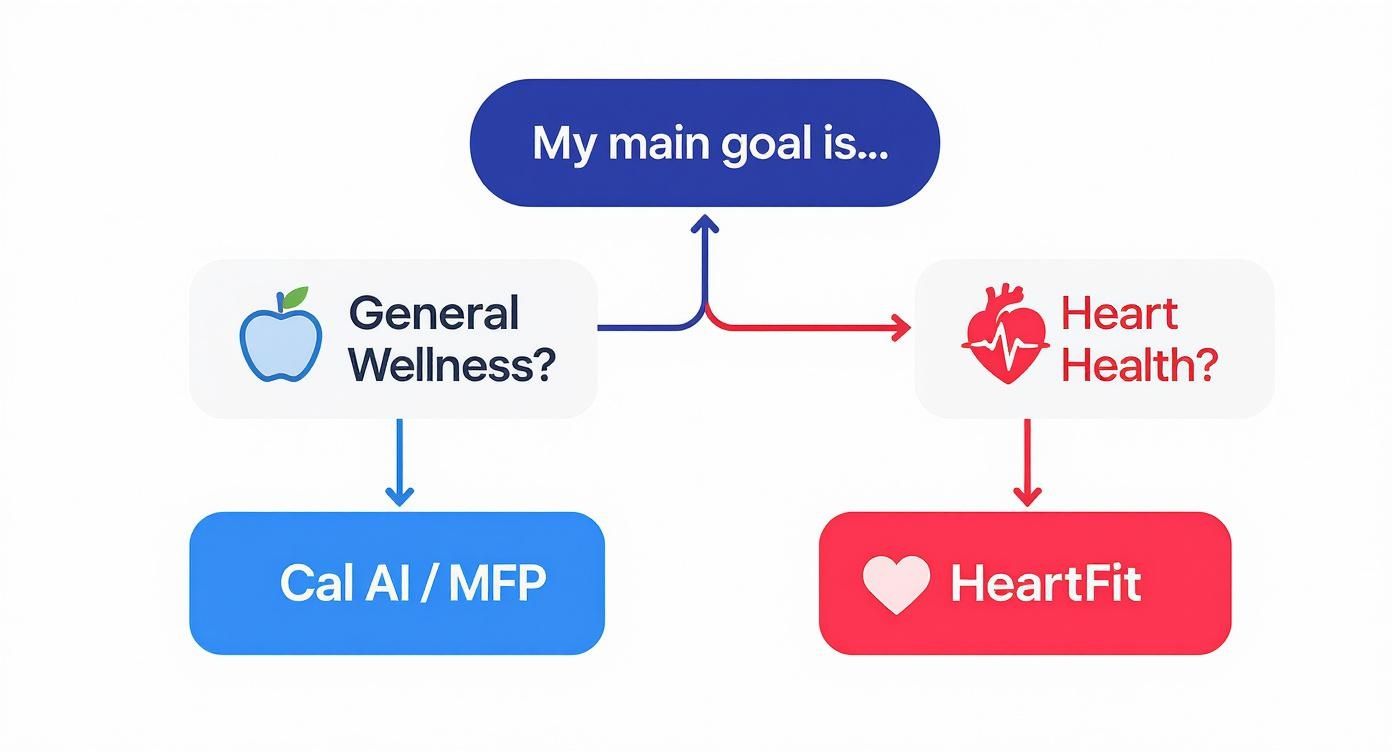
The flowchart illustrates the decision process perfectly: if general wellness is your objective, Cal AI and MyFitnessPal are top contenders. However, for a heart-first approach, a specialized tool is the more prudent choice.
The Bottom Line
- Go with Cal AI if you want a modern, fast, AI-driven experience and are willing to pay for its unique coaching features.
- Stick with MyFitnessPal if you need a massive food database, value a large user community, and want the most powerful free version available.
- Choose HeartFit (heartfit.ai) if your primary concern is cardiovascular health. It’s designed to track blood pressure, cholesterol, and other vitals that general-purpose apps do not cover.
Before making significant changes to your diet or health routine, always consult with a healthcare provider. This article is for informational purposes and should not be considered a substitute for professional medical advice.
Let's address some common questions to help you determine which app is the best fit for your life.
According to the Mayo Clinic, a normal resting heart rate for adults ranges from 60 to 100 beats per minute. Factors like fitness level, stress, and medications can influence this rate.
It's a mixed bag. Cal AI's database is growing, and its AI recognition works well for common packaged foods. However, if you frequently cook complex meals from scratch or consume less common items, you may find yourself making more manual corrections than you would with MyFitnessPal's extensive, user-vetted library.
Absolutely. MyFitnessPal Premium excels in this area. You can set precise macronutrient goals by grams or percentages, making it an excellent tool for specific diets like keto, paleo, or any low-carb plan where achieving exact macro ratios is crucial. The free version provides basic tracking but lacks this granular control.
This depends on your personality.
If you want the simplest path forward and appreciate an app that handles most of the work through photo logging and AI, Cal AI is a great starting point.
Conversely, if you learn by doing and prefer complete, hands-on control from the beginning, MyFitnessPal offers a more immersive and educational experience.
Disclaimer: This article is for informational purposes only and is not a substitute for professional medical advice. The information provided is not intended to diagnose, treat, cure, or prevent any disease. Always consult with a qualified healthcare provider before making any significant changes to your diet, exercise routine, or lifestyle.
Ready to manage your cardiovascular health with a tool designed specifically for your heart? HeartFit translates your health plan into simple, sustainable daily habits. Start your free trial and discover how motivating heart-healthy choices can be at https://www.heartfit.ai.
Download HeartFit.ai and start your 66-day journey today.



Join the #hearthealth crowd who are leveling up their heart health with HeartFit.ai