Discover the best health food scanner app for your heart. We compare AI coaching, accuracy, and key features to help you make informed dietary choices.
Staring at a nutrition label can feel like you need a PhD to understand it, especially when you're trying to protect your heart. All that tiny print, weird percentages, and chemical-sounding names make it nearly impossible to know if a food is actually good for you. This is where a health food scanner app completely changes the game. Think of it as having a personal nutritionist right in your pocket.
This article is for informational purposes only and is not a substitute for professional medical advice. Always consult a healthcare provider before making significant dietary changes.
A health food scanner app is a tool on your phone that uses the camera to scan a product's barcode and provide its nutritional information in an easy-to-understand format. It cuts through confusing jargon to give you simple, clear insights so you can make better choices for your heart health.
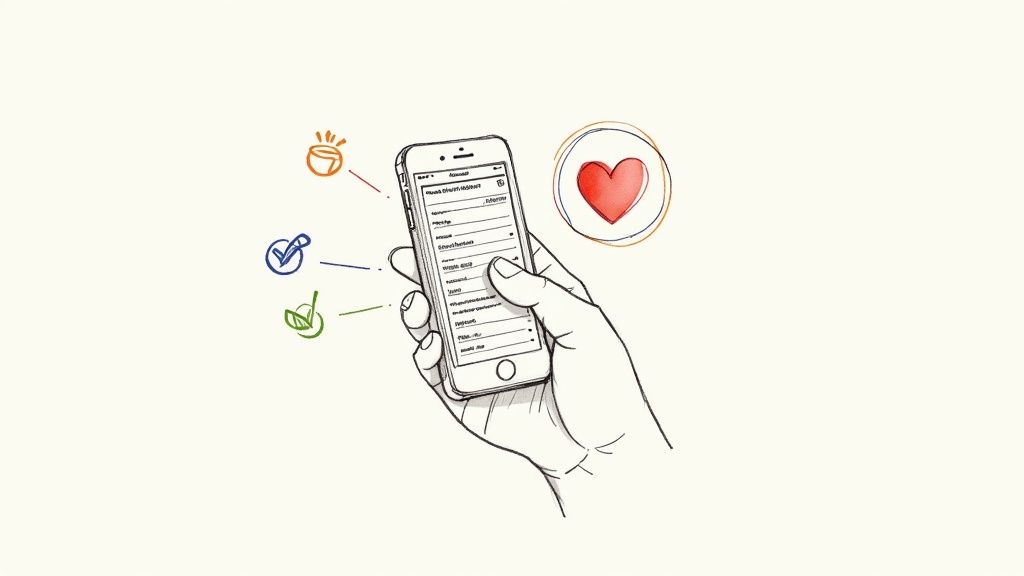
These apps go beyond just counting calories. They are built to decode complex data on the packaging, focusing on the numbers that matter for cardiovascular wellness. Instead of just a calorie count, a good heart-focused app will flag things the American Heart Association (AHA) says to watch out for, like sodium, saturated fats, and sneaky added sugars.
The market for these apps is growing rapidly. People want to take control of their health without guesswork. The global diet and nutrition app market was valued at USD 5.06 billion in 2024 and is projected to reach USD 28.36 billion by 2035, according to Data Insights Market Research. This shift shows how much we're starting to rely on these digital tools to stay healthy.
The real value of a food scanner app is the clarity and convenience it offers. In this new era of digital health, these tools are getting so sophisticated that you don't need to be an expert in how to read food labels yourself. The app does the heavy lifting for you.
With just a quick scan of a barcode, you can instantly find out:
Many apps can track your calories, but a tool designed specifically for heart health operates differently. It understands that if you're managing something like high blood pressure or cholesterol, the type of nutrients you're eating is more important than just the total calorie number.
For anyone managing cardiovascular risks, an app that prioritizes sodium, added sugar, and saturated fat over simple calorie totals provides far more relevant and actionable guidance for making daily dietary choices.
This specialized focus helps you build habits that directly support your long-term heart health. It turns every trip to the grocery store into an opportunity to make an informed, heart-smart decision.
In short, a health food scanner app simplifies nutrition by translating complex label information into actionable insights, focusing on heart-critical metrics rather than just calories.
Not all nutrition apps are built the same. Many are great for tracking calories for weight loss, but an app designed for cardiovascular wellness needs to focus on different metrics. To manage your heart health, you need a tool that digs deeper than calories and macros to focus on the specific nutrients that directly impact your blood pressure and cholesterol.
Leading health organizations, like the American Heart Association (AHA), are clear that managing cardiovascular risk means keeping a close eye on a few key dietary components. The best apps are built from the ground up to prioritize what actually matters for your heart.
This isn't about chasing a generic "health score." It's about empowering you to look at any app and see if it truly supports your long-term heart health goals. Before you download, you should be asking: is this app really equipped for the job?
A standard calorie counter might give a frozen dinner a passing grade because it fits your daily calorie budget, but it could be a disaster in the sodium department. When it comes to your heart, precision is everything. A truly effective health food scanner app must offer detailed tracking for a few critical nutrients.
These are the non-negotiables:
Ultimately, these core features form the foundation of an app that can genuinely help you manage and improve your cardiovascular health, moving beyond simple calorie counting to focus on the metrics that count.
A simple barcode scan is a basic requirement. The best apps for heart health pull in more data and offer smarter insights to give you the full picture of your wellness, guiding your choices day after day. These are the features that separate a basic tracker from a true partner in your health journey.
Here's what to look for:
According to a 2020 meta-analysis published in the journal Circulation, regular self-monitoring of blood pressure is associated with significant improvements in hypertension control. When your app can lay your dietary choices right next to those blood pressure readings, the cause-and-effect becomes crystal clear. That’s powerful motivation.
The best health food scanner app becomes your personal data hub, showing you exactly how what you eat impacts your health numbers. This integration allows you and your doctor to see the patterns, make smarter adjustments, and track the real-world results of your efforts.
Disclaimer: This article is for informational purposes only and is not a substitute for professional medical advice. Always consult a healthcare provider before making lifestyle or medication changes.
When you first look at health food scanner apps, they can all seem pretty similar on the surface. You scan a barcode, it shows you some nutrition facts. Simple, right? But for anyone trying to manage their heart health, the real value is hidden in the details. The difference between a basic food log and a tool that can genuinely help your heart lies in how it interprets data, what nutrients it prioritizes, and the advice it gives you.
Let's use a comprehensive platform like HeartFit as our benchmark to break down the features that actually move the needle for cardiovascular wellness. We'll go beyond the flashy functions to see what really delivers results for your heart.
The core job of any food scanner is to figure out what you're eating. There are two main ways they do this: old-school barcode scanning and newer AI-powered photo analysis. Each has its place.
Barcode Scanning is your best friend for anything in a package.
AI Photo Analysis is what fills in those gaps.
The Takeaway: For the best results, look for an app that combines both features. Use the barcode scanner at the grocery store for pinpoint accuracy on packaged foods, then switch to the AI photo tool for meals out and home cooking. That way, you get a complete picture without any blind spots.
A lot of apps stop after logging your food. They tell you what you ate but offer zero advice on what to do next. That's the crucial difference between a passive food diary and a proactive health partner.
Generic calorie counters are especially flawed for heart health because they treat all calories as equal. We know that's not true. A 200-calorie handful of almonds affects your cholesterol very differently than a 200-calorie donut. A truly effective health food scanner app has to get that nuance.
This is where personalized AI coaching changes the game. Platforms like HeartFit don't just count numbers; they analyze your food logs in the context of your specific goals, like lowering LDL cholesterol or getting your blood pressure down. It spots patterns and gives you real, actionable feedback.
Here’s what that looks like in practice:
This kind of proactive feedback loop helps you build better habits. It turns the app from a chore into a guide that's actually helping you make smarter choices every day.
Your diet doesn't happen in a silo. The food you eat has a direct, measurable impact on your body. The best apps understand this and connect with other data sources to give you a complete, 360-degree view of your health.
This is a total game-changer. An app that can integrate your actual lab results—your LDL cholesterol, triglycerides, and hs-CRP (a C-reactive protein test that measures general levels of inflammation in your body)—can build a nutrition plan that is hyper-personalized to you.
This means the app's advice isn't just generic "eat healthy" fluff. It's tailored to improve your specific numbers. If your LDL is high, it will start prioritizing foods loaded with soluble fiber and healthy fats. This makes your efforts so much more targeted and effective.
When scanning, you have to know what to look for. This simple hierarchy shows you how to prioritize key nutrients for heart health.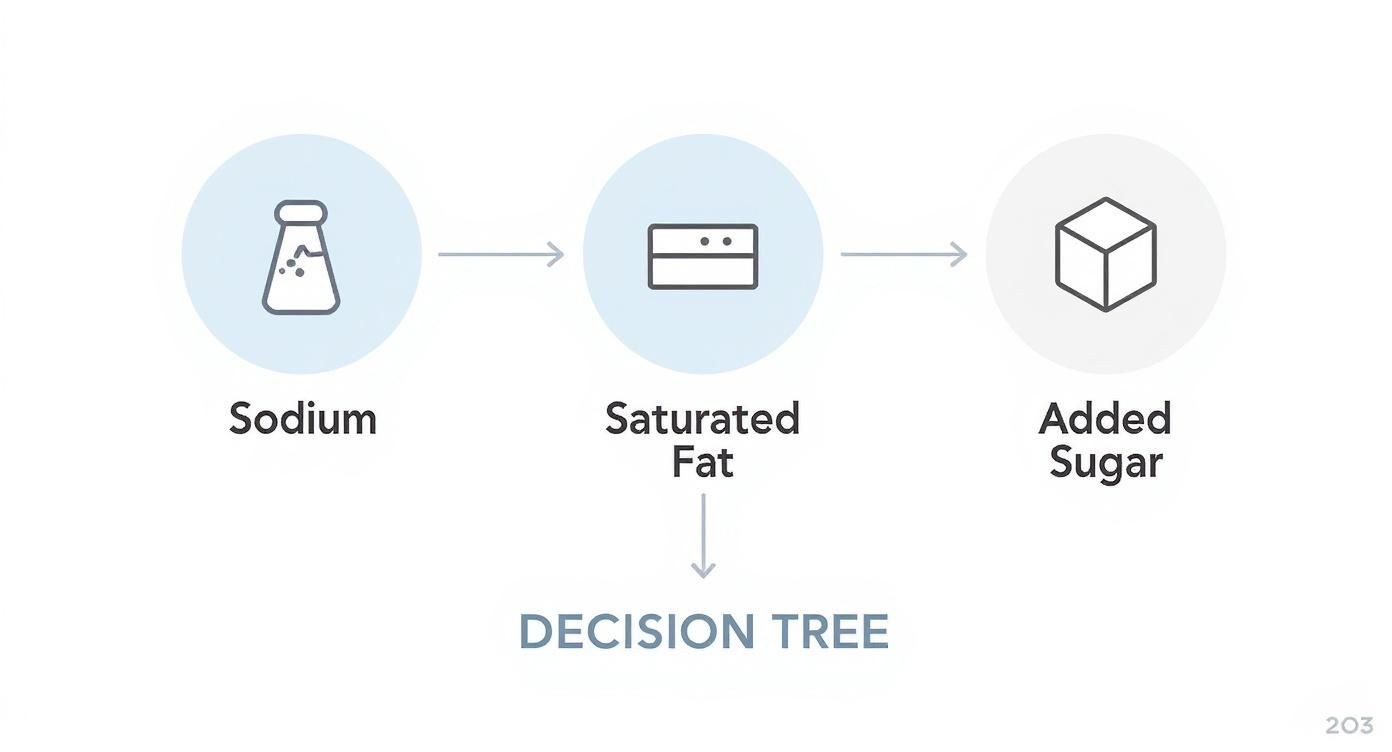
This visual guide helps you make quick decisions at the grocery store, focusing first on sodium, then saturated fat, and finally added sugar to stay on track.
When your app talks to devices like a smart blood pressure cuff or a continuous glucose monitor, you create an incredibly powerful feedback loop. You can see, in near real-time, how a specific meal affects your numbers.
The Centers for Disease Control and Prevention (CDC) points to self-monitoring as a key strategy for managing hypertension. Imagine seeing your food log right next to your blood pressure trend line. The link between that high-sodium dinner and the spike in your reading becomes crystal clear and hard to ignore.
This isn't just theory; these apps are actively changing how people buy food. The simple act of scanning an item has influenced consumer behavior. For example, Yuka, an app focused on ingredient safety, is projected to have around 14 million U.S. users by 2025. According to their own user surveys, an incredible 85% of its users say they've changed what they buy based on the app's scores. You can get more details by reading the full report on food tracking app data.
This tells us something important: when people get clear, immediate information right when they're making a decision, they're very likely to choose the healthier option. For a deeper dive, check out our guide comparing popular tools like the Yuka food scanner app.
At the end of the day, the best health food scanner app is the one that fits your life and goals. But if you're serious about managing your cardiovascular health, the choice becomes much clearer. You need to look for features that offer depth, personalization, and actionable insights.
A simple barcode scanner is a decent starting point, but a truly powerful tool goes way beyond that. It needs the flexibility of AI photo analysis, the supportive guidance of personalized coaching, and the holistic view that comes from integrating bloodwork and device data. It's this combination that empowers you to not just track what you eat, but to fundamentally improve your health.
Disclaimer: This article is for informational purposes only and is not a substitute for professional medical advice. Always consult a healthcare provider before making lifestyle or medication changes.
Knowing what an app can do is one thing, but actually weaving it into your daily routine is where the magic happens. A great health food scanner app stops being just a tool and starts feeling more like a trusted partner in your health journey. It has the power to take big, intimidating goals and break them down into small, simple actions—whether you're in the middle of a grocery store, cooking in your kitchen, or eating at a restaurant.
It's all about building habits that stick. Instead of getting bogged down by a long list of dietary dos and don'ts, the app gives you clear, immediate feedback right when you need it. Every meal becomes a chance to do something good for your heart.
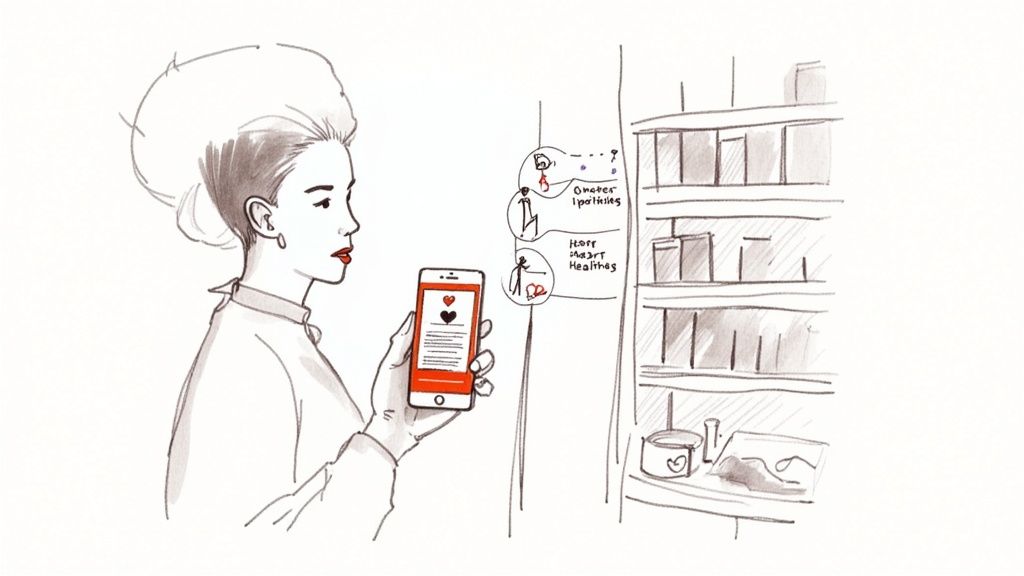
Let's be honest: the grocery store can feel like a battlefield for healthy eating. Misleading labels and clever marketing can easily throw you off track. This is where a scanner app becomes your secret weapon.
While the app is a massive shortcut, brushing up on the fundamentals of how to read nutrition labels effectively will make you an even smarter shopper. Once you're home, you can keep the momentum going by logging your ingredients as you cook, which keeps your daily tracking accurate and effortless.
Eating out can feel like a total gamble for your health goals. With no nutrition labels in sight, it's incredibly easy to accidentally eat a meal with an entire day's worth of sodium.
An app with AI photo analysis helps you take back some control. Just snap a picture of your plate, and the app will give you its best guess on the nutritional info. It's not as pinpoint-accurate as a barcode scan, of course, but it's a fantastic guide for staying mindful and making better choices when you aren't the one doing the cooking.
According to a 2019 study in JMIR mHealth and uHealth, a journal on PubMed, individuals who consistently used mobile apps for dietary tracking achieved greater success in weight management. This principle of awareness and accountability is key for managing heart health metrics like blood pressure and cholesterol.
This feature turns what could be a setback into just another opportunity to be mindful. You can get a handle on your intake and adjust what you eat for the rest of the day.
If you're following a specific plan like the DASH diet, which is often recommended by the National Institutes of Health (NIH), you know it can be a lot to juggle. You have to track sodium, potassium, and magnesium, among other things.
This is where a dedicated health food scanner app really shines. You can set your specific daily targets for these nutrients, and the app handles all the tedious tracking for you. This makes it so much easier to stick with your plan and support your blood pressure goals without doing constant math in your head. For a deeper dive, check out our guide on building a heart-healthy diet plan.
One of the most powerful things about using a scanner app is the data it collects. Many of the better apps let you export your food logs and progress reports into a simple format, like a PDF.
This completely changes the conversation with your doctor or dietitian. Instead of trying to remember what you ate last week, you can show them detailed records. This data-driven approach helps your provider:
You become an active, informed partner in your own healthcare, leading to more productive conversations and, ultimately, better health outcomes.
When you're trying to manage your cardiovascular health, the gap between a generic calorie counter and a truly specialized tool is massive. Looking at the criteria that really matter for heart health—like precise nutrient tracking, personalized coaching, and data integration—HeartFit stands out as a leading choice. This health food scanner app wasn’t just built to log meals; it was designed to actively guide you toward better heart-focused habits.
Plenty of apps can count calories, but HeartFit zooms in on the metrics that have a direct impact on your blood pressure and cholesterol. It puts a laser focus on tracking things like sodium, saturated fats, added sugars, and fiber, which lines up perfectly with what organizations like the American Heart Association recommend. This specialized approach means every scan and log entry gives you relevant, useful feedback for your cardiovascular goals.
One of the biggest things that sets HeartFit apart is its AI-driven coaching. Most food diaries are passive—you put data in, and that’s it. HeartFit is different. Its system actually analyzes your eating patterns and gives you personalized, supportive nudges to keep you on track. It helps you see the connection between what you eat and your health goals.
This proactive guidance turns the app into a genuine partner in your health journey. Instead of just staring at numbers, you get advice that makes sense in the context of your life, helping you build habits that stick. It’s a shift from simple tracking to real, sustainable behavior change.
For anyone actively working to lower their blood pressure or cholesterol, having a tool that offers tailored feedback is a game-changer. It turns a mountain of data into a clear path forward, making a heart-healthy lifestyle feel achievable instead of overwhelming.
This kind of personalization is why diet and nutrition apps have become so popular, with over 200 million downloads globally—they make managing health feel more accessible. HeartFit takes this a step further by tailoring its guidance to your specific cardiovascular needs. You can dig into more stats about how nutrition apps are changing user habits over at Market.us.
HeartFit's real power comes from its ability to plug into your wider health ecosystem. The platform is designed to connect with your bloodwork results and health devices, creating a full 360-degree view of your wellness.
This holistic view provides a level of insight that standalone food scanners just can't offer. It directly connects your daily choices to tangible health outcomes, which is an incredible motivator for staying on track. You can explore a detailed breakdown of HeartFit's connected features to see exactly how these integrations work.
For anyone serious about using a health food scanner app to support their heart health, HeartFit offers a uniquely focused and data-driven solution that's tough to beat.
Disclaimer: This article is for informational purposes only and is not a substitute for professional medical advice. Please consult with your healthcare provider before making any changes to your diet, lifestyle, or medications.
Diving into the world of nutrition tech can bring up a few questions. As you think about making a health food scanner app part of your routine, it’s smart to get a handle on how they actually work, what you can realistically expect from them, and how they protect your personal information. Let's clear up some of the most common questions.
This really comes down to the technology under the hood. For packaged foods, barcode scanning is usually very accurate. It pulls data directly from massive, verified product databases, giving you a reliable look at ingredients and nutrition facts.
AI-powered photo scanning—for that homemade chili or restaurant salad—is different. It's an educated estimate. While the tech is getting impressively smart, it's not going to be as precise as a barcode scan. The best apps are constantly training their AI models to get sharper. A 2018 study in the Journal of Medical Internet Research found that while automated dietary assessment has promise, accuracy can vary. It’s best to treat photo scans as a solid guide, not a perfect measurement.
In a word: no. A health food scanner app is a fantastic tool for education and tracking, but it is not a substitute for professional medical advice. The American Heart Association is clear that any significant changes to your diet or lifestyle should happen in partnership with a qualified healthcare provider.
Think of your app as your personal data assistant. It helps you build a detailed record of your daily habits that you can then share with your doctor or a registered dietitian. This information makes your appointments far more productive, allowing your medical team to give you advice that’s truly tailored to your health and your life.
Data privacy is a critical consideration when you're choosing a health app. Reputable developers will have a transparent privacy policy and follow strict data protection laws, like GDPR in Europe or HIPAA in the U.S. for certain types of health information, to keep your data safe.
Before you download any health food scanner, take a minute to read its privacy policy. You want to see clear, simple language about data encryption, how your info is stored, and whether it’s ever shared with other companies. A trustworthy app will put your security first.
Apps built for serious health management tend to have much stronger security measures in place. It's also on you to do your part—always use a strong, unique password for your account to add an extra lock on your personal health data.
A normal resting heart rate for most adults is between 60 and 100 beats per minute (bpm). According to the Mayo Clinic, a lower resting heart rate generally implies more efficient heart function and better cardiovascular fitness. For example, a well-trained athlete might have a normal resting heart rate closer to 40 bpm. However, you should consult your doctor if you are concerned about your heart rate.
Ready to turn insights into action? HeartFit is more than just a scanner—it’s an AI-powered partner that helps you build sustainable, heart-healthy habits. Start your free trial today and see how personalized coaching can transform your health journey. Visit https://www.heartfit.ai to learn more.
Download HeartFit.ai and start your 66-day journey today.



Join the #hearthealth crowd who are leveling up their heart health with HeartFit.ai