Discover how the Yuka food scanner app works, its scoring system, and how to make healthier choices. Read our complete guide to shopping smarter.

The Yuka food scanner app is a handy tool that pops right on your phone, letting you scan the barcodes on food and cosmetics to get an instant health score. Think of it as having a pocket nutritionist to help you make sense of confusing labels right there in the grocery aisle.
Disclaimer: This article is for informational purposes only and is not a substitute for professional medical advice. Always consult with a healthcare provider before making significant changes to your diet or lifestyle.
You know the feeling. You're standing in front of two cereal boxes. One screams "all-natural," the other boasts "low-fat." Marketing buzzwords like these can turn a simple shopping trip into a confusing guessing game. The Yuka app was built to cut right through that noise, giving you clear, science-backed insights on your phone.
At its heart, the app is like a simple traffic light for your groceries. You just point your phone’s camera at a product's barcode, and in a flash, Yuka serves up a score out of 100 along with a simple color-coded rating. It tells you pretty much everything you need to know, fast.
The whole system is designed for quick decisions, helping you see at a glance which products are a good choice and which are probably better left on the shelf. The ratings couldn't be more straightforward:
This immediate visual cue helps you make smarter choices without needing a PhD in nutrition. And if you scan something that gets a "Bad" rating, Yuka doesn't just leave you hanging—it often suggests similar, healthier alternatives, making it easy to swap out the not-so-great items in your cart. For a deeper dive into how it stacks up against other trackers, check out our guide on the Yuka app vs. MyFitnessPal.
To give you a quick reference, here's how the scoring breaks down:
This simple system makes it easy to quickly gauge a product's overall health impact while you're shopping.
Yuka first launched in France back in 2017 and has since exploded in popularity, now serving over 60 million users around the world. With roughly 25 products scanned every second, it's clear people are hungry for more transparency.
Part of its success comes from its fiercely independent, ad-free model. Yuka makes its money solely from an optional premium subscription, which means its ratings can't be bought or influenced by the food and cosmetic industries. This commitment ensures the advice you get is always unbiased.
By bringing this kind of clarity into the grocery store, the Yuka food scanner app turns shopping from a chore into an act of self-care. It gives you the power to look past the flashy packaging and understand what you’re really putting in your body—a simple but powerful first step toward building healthier, more mindful habits.
To really trust an app that’s guiding your food choices, you need to peek under the hood. How does the Yuka food scanner app actually come up with its scores? It's not just a random number; it’s a calculated rating based on a weighted algorithm that dials in on what matters most for your health.
Yuka’s entire scoring system is built on three core pillars. Each one contributes a specific percentage to that final score out of 100, giving you a transparent look at why a product lands where it does.
The app’s final calculation is broken down into a pretty straightforward, evidence-based formula. This makes sure that the factors with the biggest impact on your health have the most say in the final score.
This simple, color-coded system is designed to help you make snap decisions in the grocery aisle.
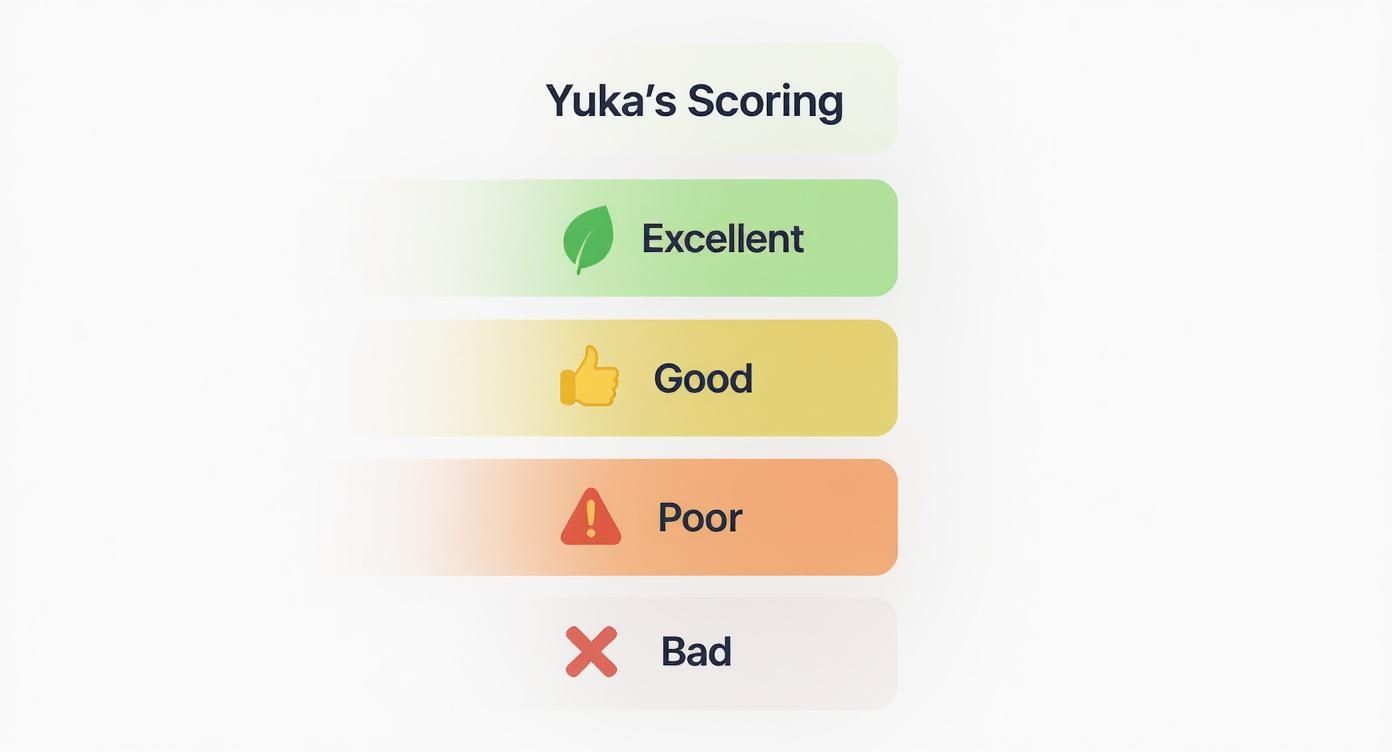
It’s all about connecting that score out of 100 to one of four clear ratings, so you know exactly where an item stands at a glance.
Making up 60% of the total score, nutritional quality is clearly the main event. For this part, Yuka leans on the Nutri-Score system. This is a well-regarded front-of-pack labeling method originally developed by French public health authorities and supported by reputable organizations, including the World Health Organization (WHO).
The Nutri-Score approach is all about balance. It subtracts points for nutrients you want to limit and adds points for the ones you want more of.
What loses points?
What gains points?
To get the most out of this, it helps to have a baseline knowledge, like understanding Nutrient Reference Values (NRVs) on food labels.
Next up, accounting for 30% of the score, is the analysis of additives. Yuka doesn't just paint all additives with the same brush. It classifies them based on potential health risks, drawing from a deep well of scientific literature and referencing studies from respected bodies like the European Food Safety Authority (EFSA) and the National Institutes of Health (NIH).
Each additive gets assigned one of four risk levels:
This is where it gets interesting. A single "Hazardous" additive will automatically cap a product's score at a measly 24/100, dropping it straight into the "Bad" category, no matter how good its nutrition profile is. Likewise, a "Moderate Risk" additive limits the score to 49/100. This shows just how seriously Yuka takes the presence of potentially harmful stuff.
The final 10% of the score is a simple, all-or-nothing bonus. If a product has an official organic certification, it gets the points. This part of the score acknowledges that organic farming avoids synthetic pesticides and GMOs, which aligns with a more holistic view of healthy eating.
If it's certified organic, it gets the full 10 points. If not, it gets zero. Simple as that.
By weaving these three pillars together, the Yuka food scanner app delivers a detailed score that gives you a much clearer picture of what's really inside your food.
There's a specific "aha" moment that happens the first time you use an app like Yuka. You scan a pantry staple—maybe a granola bar you’ve always considered a healthy choice—only to see a jarring red "Bad" score flash across your screen. Suddenly, all the hidden sugars, questionable additives, and low nutritional value are laid bare. It completely changes how you see the products you buy every single day.
This isn't just about getting data; it's about getting instant, clear feedback that actually triggers a change in behavior. Yuka's simple color-coded system creates a direct feedback loop. A green score feels like a pat on the back, validating a good choice. But an orange or red score? That creates a moment of hesitation, forcing you to reconsider your purchase right there in the grocery aisle.
This simple interaction completely shifts the power dynamic. Shoppers go from passively believing the marketing claims on the front of the box to actively questioning the nutrition label on the back. This is where the app truly shines: it doesn't just rate products. It teaches you how to be a smarter shopper, improving your nutritional literacy one scan at a time.
The data on Yuka's influence is pretty telling. According to the app's own social impact report, 94% of users reported they have put products back on the shelf after getting a negative "red" rating. That number alone shows the app’s powerful deterrent effect against unhealthy items.
The same report found that 92% of users now buy fewer ultra-processed foods. This is a significant finding, especially since research published in journals like The BMJ has linked high consumption of these foods to poor cardiovascular outcomes. You can dig into the full findings yourself to learn more about Yuka's social impact.
This change isn't just about avoiding the bad stuff; it's about finding the good stuff. When Yuka flags an item as "Poor" or "Bad," it often suggests healthier alternatives. This turns a moment of disappointment into a constructive one, guiding users toward better options without leaving them guessing. For instance, scanning a sugary kids' yogurt might point you to a plain Greek yogurt with more protein and no added sugar.
Disclaimer: This article is for informational purposes only and is not a substitute for professional medical advice. Always consult a healthcare provider before making significant dietary or lifestyle changes.
Over time, this cycle of scanning, learning, and swapping helps you build a much deeper understanding of nutrition. You start to internalize the why behind the scores. You begin to spot problematic additives on your own and get better at reading complex food labels without needing to scan every single thing.
This educational effect is probably the Yuka app's most valuable contribution. It gives people the confidence to make conscious, informed decisions that build lasting habits. Grocery shopping turns from a chore into an act of self-care.
The result is a more mindful consumer who isn't so easily swayed by clever marketing and is more in tune with what their body actually needs. This sense of empowerment is the real foundation for building a sustainable, healthier lifestyle—one shopping trip at a time.
Let's be real: no single app holds all the secrets to healthy eating, and the Yuka food scanner app is no different. To get the most out of it, you need to understand what it does well and where it falls a little short. Think of it as a helpful guide in the grocery aisle, not the final word on your entire diet.
Its biggest win is its complete independence. Yuka is 100% ad-free and doesn’t take a dime from food or cosmetic companies. This means its ratings are unbiased and focused squarely on you, the consumer, which builds a level of trust that’s hard to find.

Combine that with a super simple interface and a massive, ever-growing product database, and Yuka makes it way easier to decipher confusing food labels. It gives you the power to make quick, informed decisions on the fly, no nutrition degree required.
Yuka’s design and core mission give it a few clear advantages that have made it such a popular shopping buddy.
A great example of this is the French supermarket chain Intermarché, which reportedly reformulated 900 recipes and ditched 140 additives after shoppers, armed with Yuka ratings, demanded better. The app even has a feature that lets you contact brands directly about iffy ingredients. This taps right into what today's shoppers want—as noted in the evolution of consumer-brand interaction at TechCrunch, modern consumers increasingly demand transparency from brands.
As great as it is, Yuka isn't perfect. Knowing its limitations helps you use it as the smart guide it’s meant to be, not as a set of rigid rules.
A common critique is how its algorithm—specifically the Nutri-Score system it relies on—rates certain foods. For instance, healthy fats, which the American Heart Association states are crucial for heart health, can sometimes get a poor rating. A high-quality extra virgin olive oil might get a mediocre score simply because of its fat content, overlooking all the beneficial monounsaturated fats and antioxidants it contains.
This really gets at a key point: nutrition is complicated, and boiling it down to a single score can sometimes miss the bigger picture. The app gives you a snapshot, not a full dietary analysis. If you want to dig deeper, check out our guide to the best food scanner app choices.
A Note on Portion Control: It’s super important to remember that a "Good" or "Excellent" score isn't a free pass to eat as much as you want. Portion size is still a cornerstone of healthy eating, and that's something the app's score doesn't directly factor in.
Also, while the database is huge, you might still scan a niche, artisanal, or brand-new product that isn't in the system yet. This can leave you with some gaps, especially if you love shopping at local farmers' markets or specialty food shops.
At the end of the day, the Yuka food scanner app is a fantastic educational tool for the average shopper. When you understand its power in driving transparency and its limits in judging nuanced nutrition, you can use it wisely to build healthier habits, one scan at a time.
Disclaimer: This article is for informational purposes only and is not a substitute for professional medical advice. Always consult with a healthcare provider before making changes to your diet or lifestyle.
The Yuka food scanner app is a fantastic tool for getting a quick read on what’s in your grocery cart. It's a great first step toward building awareness about what you're eating. But when you’re managing a serious goal like improving heart health, a general food scanner is just one piece of a much larger puzzle.
Yuka is great at answering, "What's in this product?" A truly targeted approach to heart health, however, needs to answer, "Why does this matter for my body and my specific goals?" This is where you graduate from a general scanner to a more specialized health toolkit. It's about connecting your daily choices to real, measurable health outcomes and turning information into a plan that works for you.
While Yuka gives you a score, other tools can show you exactly how those food choices affect your body in real-time. For instance, exploring real-time insights from Continuous Glucose Monitoring (CGM) can offer a powerful layer of personalization, revealing your unique biological responses to different foods.
To build a truly effective system for heart health, it's worth looking at apps that go deeper and are built around your unique data.
Moving beyond simple scanning, these habit and tracking apps offer more personalized insights and action plans tailored to your specific health needs.
While each of these tools has its strengths, some are designed to bridge the gap between general advice and your personal biology.
Here’s the thing about any food scanner: it can't see your personal health data. An app like HeartFit is designed to fill that critical gap. It picks up where a general scanner leaves off by integrating your actual lab results—like your levels of LDL cholesterol (the "bad" kind).
So, instead of just giving a product a generic "good" or "bad" score, HeartFit translates your doctor's advice and your bloodwork into a simple, sustainable habit-building system.
Let's say your labs show elevated LDL. HeartFit helps create a personalized plan focused on foods known to support healthy cholesterol levels. It then turns these recommendations into simple, swipeable daily tasks, making it genuinely easy to stick with your plan.
You can learn more about building a sustainable heart-healthy diet plan in our detailed guide.
This approach transforms abstract health advice into concrete daily actions. You're no longer just avoiding "bad" foods; you're actively working to improve specific health markers with a clear, guided strategy. By connecting your diet directly to your lab data, HeartFit provides a proactive, customized path to managing your cardiovascular health.
Disclaimer: This article is for informational purposes only and is not a substitute for professional medical advice. Always consult a healthcare provider before making significant lifestyle or medication changes.
Jumping into any new health app always brings up a few questions. As you start using the Yuka food scanner app in the grocery aisles, you might wonder how it's free, what to do when a product isn't found, or if it's the right fit for your specific dietary needs. Let's clear up some of the most common queries.
My goal here is to give you the straightforward, practical info you need to use the app with confidence.
Yes, the main functions of the Yuka app are completely free. You can scan as many products as you want, check their health scores, and get recommendations for better alternatives without ever paying a dime. Keeping this core service free is central to Yuka’s mission of making transparent health information available to everyone.
To keep the lights on and fund development, Yuka does offer a premium subscription. This paid version is totally optional but adds a few handy features for users who want a bit more out of the app:
Crucially, the app is 100% ad-free. This helps it stay independent and ensures the advice you get is unbiased.
Yuka keeps its business model simple and transparent. The company’s only source of income is the optional premium subscription mentioned above.
This was a very deliberate choice. By relying solely on its users for support, Yuka ensures its ratings and recommendations remain completely independent from the influence of food and cosmetic brands. They don't take money for ads or to give products a better score. This means you can trust that a product’s rating is based purely on its ingredients, not a behind-the-scenes marketing deal.
With millions of products out there and new ones hitting the shelves all the time, you're bound to scan something that isn't in Yuka's database yet. When that happens, the app doesn't just give you an error message—it invites you to help out.
Yuka relies on its community to help grow its database. If an item isn’t found, the app will prompt you to:
This crowdsourcing is a big part of why the app's database has become so comprehensive and keeps getting better over time.
This is a really important question, especially for anyone managing allergies, intolerances, or following a strict diet like veganism or gluten-free. While Yuka is a fantastic tool for getting a general sense of a product's health profile, it should not be your primary tool for managing specific medical or dietary needs.
The premium alerts for ingredients like gluten are a helpful first check, but they aren't a substitute for carefully reading the label yourself. Always look for official certifications (like "Certified Gluten-Free") and check the allergen warnings on the package. As health authorities like the U.S. Food & Drug Administration (FDA) advise, the label is always the most reliable source of truth for avoiding allergens.
Important Reminder: The Yuka app is a helpful guide, but it is not a replacement for professional medical advice. Always talk to your doctor or a registered dietitian for guidance that’s personalized to your specific health conditions and dietary needs.
For those who want to connect their diet directly to specific health metrics, HeartFit offers a more targeted approach. It takes your bloodwork results and turns them into a simple, gamified system for building habits that directly support your heart health goals. Learn more and start your free trial at https://www.heartfit.ai.
Download HeartFit.ai and start your 66-day journey today.



Join the #hearthealth crowd who are leveling up their heart health with HeartFit.ai