Discover the function health vs prenuvo scan: key tech differences, costs, and diagnostic scope to guide proactive health decisions.
The core difference between Function Health and a Prenuvo scan comes down to their fundamental approach. Prenuvo gives you an incredibly detailed anatomical snapshot. It uses a radiation-free, whole-body MRI to spot structural problems, like tumors. Function Health, on the other hand, offers a hybrid model. It brings together AI-powered imaging and over 100 blood biomarkers to paint a fuller picture of your health, covering both structure and function.

The world of personal health is making a big shift. We're moving away from just reacting to sickness and toward proactively screening our bodies to catch potential issues long before symptoms ever show up.
Two of the biggest names leading this charge are Function Health and Prenuvo. While both services give you powerful insights, they get there using very different philosophies and technologies. Grasping this distinction is the key to figuring out which one is right for you. One is a master of anatomical imaging; the other integrates that imaging with deep biological data for a much broader view.
To quickly see how different they are, think about their primary goals. Prenuvo is an imaging specialist, plain and simple. Function Health, which now partners with Ezra for its scans, operates more like a comprehensive health platform.
This quick-reference table breaks down what that means in practice.
This initial comparison of Function Health vs. Prenuvo Scan really just scratches the surface. While their ultimate goal is early detection, the way they get there—and the kind of information you walk away with—couldn't be more different.
Disclaimer: This article is for informational purposes only and is not a substitute for professional medical advice. It is essential to consult with a qualified healthcare provider before making any decisions about your health, including undergoing diagnostic screenings or changing your lifestyle. Information from these scans should always be discussed with your personal physician to determine the appropriate next steps.

To really get what separates Function Health from Prenuvo, you have to look under the hood at the technology each one uses. These aren't just slightly different versions of the same thing. They represent two fundamentally different philosophies for looking at your health—one zeroed in on anatomical imaging, the other layering functional data on top.
Prenuvo’s whole approach is built around its own custom MRI scanners. It’s interesting because many hospitals use more powerful 3T magnets, but Prenuvo has intentionally optimized its 1.5T MRI machines for the specific job of whole-body screening. Paired with advanced techniques like diffusion-weighted imaging (DWI), this choice allows them to capture incredibly clear, high-resolution images with very little distortion during their standard 60-minute scan.
The name of the game here is anatomical precision. By minimizing imaging "artifacts"—those little glitches that can obscure details—their radiologists get a cleaner look at subtle structural changes, like small lesions or shifts in tissue density that might otherwise go unnoticed.
Everything Prenuvo does, from its hardware to its software, is engineered for one single purpose: to create the most detailed anatomical map of your body possible. This laser focus is what truly sets them apart.
At the heart of medical imaging technology lies the global standard for medical imaging, known as DICOM, the global standard for medical imaging. This protocol ensures that the high-resolution images from a Prenuvo scan can be stored, viewed, and shared with other clinicians consistently.
Function Health, working with its partner Ezra, casts a much wider net. It brings together anatomical imaging and a deep dive into your body's functional biology to give you a more holistic health picture. Think of it as integrating two powerful data streams into one comprehensive report.
The first piece is the imaging. Function Health’s partner, Ezra, provides AI-enhanced full-body MRI scans. These AI algorithms work alongside the radiologists, flagging potential areas of concern and essentially acting as a second set of expert eyes to support the human analysis. The aim is to boost both efficiency and accuracy.
But the MRI is only half the story. The other critical component is Function Health's extensive lab work.
In short, Prenuvo hands you an exceptionally detailed architectural blueprint of your body. Function Health gives you that same blueprint, but also includes the schematics for the electrical, plumbing, and HVAC systems. It reveals not just what your body looks like, but how well it’s actually running.
For those digging deeper into different screening tools, our comparison of Prenuvo vs. Mito Health offers more insight on imaging-focused services. Understanding this core difference is the key to figuring out which approach is the right fit for your health goals.
When you strip away the marketing, the real question in the Function Health vs. Prenuvo debate is simple: What can each service actually find? Getting a handle on their diagnostic reach and the clinical accuracy behind their claims is the only way to make a smart choice for your health.
The core difference really boils down to their approach to data and validation. Prenuvo is pretty open about its findings, publishing internal data from its massive library of scans. Function Health reports some exciting initial numbers but hasn't yet released the same kind of detailed, peer-reviewed data for its combined imaging-and-biomarker model. This makes a direct, apples-to-apples accuracy comparison a bit tricky.
Prenuvo’s singular focus on imaging makes it easier to analyze what it can detect, and they have a huge dataset to back it up. By crunching the numbers on tens of thousands of scans, they can offer real statistics on what they find and how often those findings are the real deal.
This data-driven method gives you a certain level of confidence in the results. For instance, Prenuvo's internal analysis of 39,265 scans between October 2023 and July 2024 flagged potential cancer in about 2% of patients. Of those who went for a biopsy, the positive confirmation rate was a significant 50%. On top of that, a false negative rate of just 0.2% provides powerful reassurance if your scan comes back clear. You can dig into these findings more over at NewDawn.Health.
This screenshot from Prenuvo's website gives a good visual breakdown of the kinds of things they typically spot.
What's interesting is that while they catch major issues, a huge chunk of their discoveries are moderate or mild things like spinal degeneration—information that’s incredibly valuable for making preventative lifestyle tweaks.
Function Health, working with their imaging partner Ezra, reports a potential early cancer detection rate of 6%. That number definitely catches your attention, but it needs a little context. This figure comes from the imaging part of their service, but as of right now, there isn't publicly available, peer-reviewed data on biopsy confirmation rates or false-negative stats for their specific model.
The real power of Function Health is how it combines two very different types of data: anatomical and biological.
Key Insight: A "normal" MRI from Prenuvo gives you solid reassurance about your structural health. A "normal" report from Function Health gives you that same structural peace of mind plus a deep dive into your functional health, potentially flagging risks before they ever show up on a scan.
This two-pronged approach casts a much wider diagnostic net. For example, an MRI might not detect early arterial plaque, but Function Health’s advanced lipid panel—which includes ApoB and Lp(a)—can reveal a high genetic risk for cardiovascular disease. You can see just how deep they go by checking out our guide on the full Function Health biomarkers list.
Ultimately, the conversation around clinical accuracy isn't black and white. Prenuvo delivers validated, imaging-specific accuracy with a proven track record. Function Health offers a wider scope by mixing imaging with biological data to catch a broader range of health risks, even if its integrated model is still building its public evidence base. Your choice really depends on what you value more: a deeply validated structural screen or a more comprehensive, functional health assessment.
Disclaimer: This article is for informational purposes only and is not a substitute for professional medical advice. Always consult with a qualified healthcare provider before making any lifestyle changes or decisions regarding your medical care.
Once you get past the technical details of the scans, the real-world factors of cost and user experience come into play. These are often the deciding factors, shaping not only what's affordable but also what best fits your approach to long-term health.
The financial models couldn't be more different. Prenuvo keeps it simple: a one-time fee for a specific service. Their whole-body scan runs $2,499. It's a significant out-of-pocket cost, but it's a straightforward transaction for an incredibly detailed anatomical picture.
Function Health, on the other hand, is built around a membership model. Instead of a one-off payment, you're subscribing to a continuous health monitoring service that bundles extensive lab work with an Ezra scan. It’s designed for ongoing tracking, not a single snapshot. You can see a full breakdown of the Function Health membership cost to get a feel for how the subscription compares to a single scan fee.
Accessibility and the on-site experience also diverge quite a bit. Prenuvo has staked its reputation on a consistent, high-end patient journey by operating its own clinics. This means from the moment you book to the scan itself, everything is meticulously controlled using their own custom-tuned MRI machines.
Prenuvo's complete control over its clinics is a huge part of its value proposition. It guarantees a uniform standard of quality, which is a big deal when you're making this kind of investment in your health.
Function Health partners with Ezra, which uses a network of existing imaging centers. While this approach dramatically opens up geographic access, it can lead to a more variable experience. The specific machinery, the clinic's atmosphere, and even the waiting room decor can differ from one partner location to another.
Looking at the entire process from start to finish really highlights their different philosophies. Both services offer easy online booking, but what happens next sets them apart.
The Prenuvo Patient Journey:
The Function Health User Journey:
Ultimately, Prenuvo offers a premium, product-like service focused on delivering crystal-clear anatomical insights. Function Health provides a broader, integrated health management service where the scan is just one piece of a much larger data puzzle. Your decision hinges on whether you're after a definitive structural check-up or a comprehensive, data-driven partner for your ongoing health journey.
Disclaimer: This article is for informational purposes only and is not a substitute for professional medical advice. Always consult with a qualified healthcare provider before making any lifestyle changes or decisions regarding your medical care.
Figuring out whether to go with Function Health or Prenuvo isn't about which one is flat-out "better." It's about which tool is right for your specific health goals. The best choice really comes down to your personal health philosophy, your risk factors, and the kind of information you find most valuable for the long haul.
This quick decision tree can help you start mapping out which path makes the most sense for you.
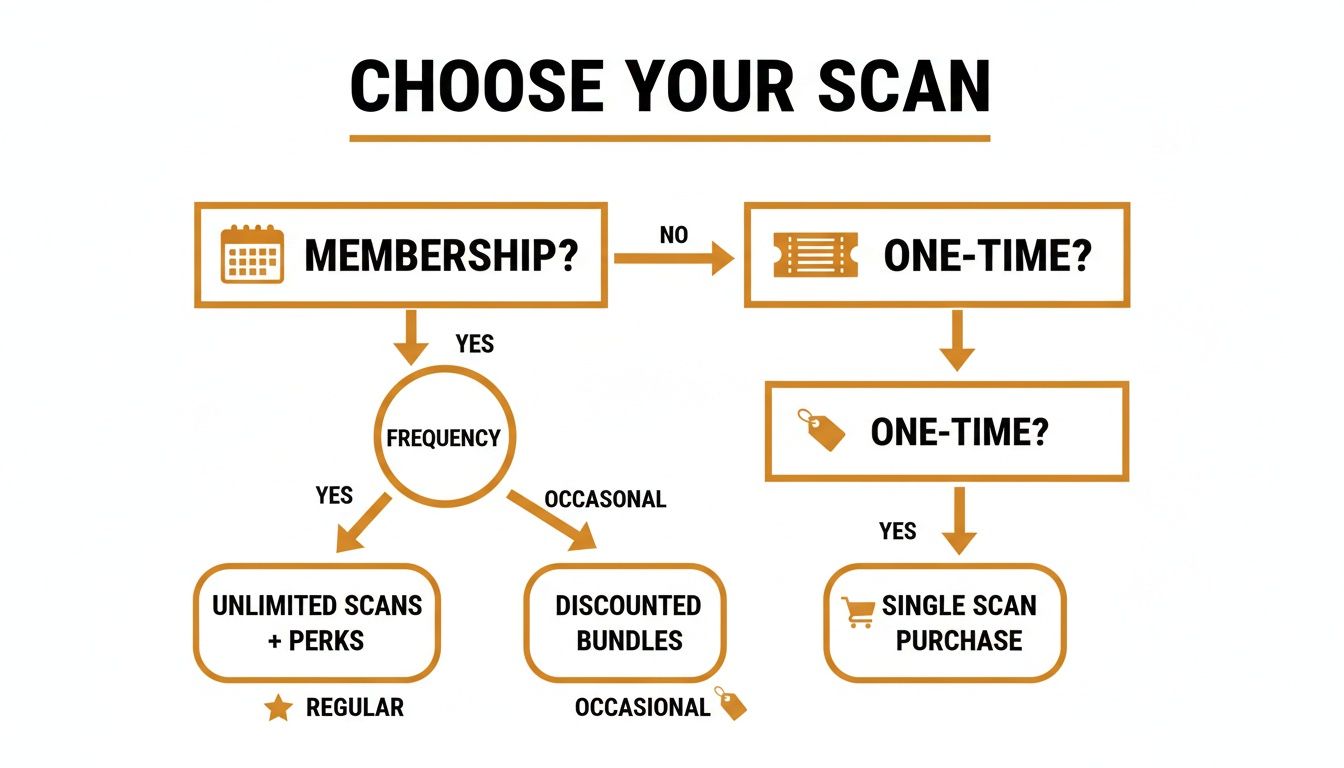
As the visual suggests, there's a fundamental split here. One service is built for ongoing, data-rich membership, while the other shines as a powerful, one-off anatomical screening.
You should lean toward a Prenuvo scan if your main focus is catching structural problems early, especially cancer. This is the perfect fit for anyone who is zeroed in on getting peace of mind about their physical anatomy.
Prenuvo is likely for you if this sounds familiar:
For the Proactive Planner, Prenuvo's value is in its validated, data-backed precision. The knowledge that their scan has an extremely low false-negative rate delivers a specific and powerful kind of reassurance that no other data can match.
This person values the depth of anatomical detail more than the breadth of functional data. They want the highest-quality structural snapshot they can get to use as a baseline for future health decisions.
On the other hand, Function Health is made for people who view health as a dynamic system that requires constant monitoring and fine-tuning. This user wants to understand not just the "what" (structure) but also the "why" (function).
Function Health is probably your best bet if you identify with this approach:
A great example is someone actively managing their heart health. While an MRI can spot structural issues, Function Health’s biomarker panel—which includes tests for LDL cholesterol (the "bad" kind) and inflammatory markers—can identify risks long before they’d ever show up on a scan. Organizations like the American Heart Association have long emphasized that knowing these numbers is a cornerstone of prevention.
Ultimately, your choice in the function health vs prenuvo scan debate is deeply personal. It's a strategic decision based on whether you're after a definitive anatomical audit or a comprehensive, ongoing partnership in optimizing your health.
Getting a detailed report from a Function Health or Prenuvo scan is an incredible starting point. But the real value isn't in the data itself—it's in what you do with it. The ultimate goal is to translate those diagnostic insights into sustainable, protective habits, especially for your long-term cardiovascular health. This is where the real work begins.
Think of your scan results as your personal health map. Whether it’s an anatomical flag from Prenuvo or a biomarker trend from Function Health, this is your baseline. After discussing the findings with your doctor, you'll have the foundation for a personalized health plan. The challenge, then, is to move from simply knowing your numbers to actively influencing them with small, consistent actions.
It’s one thing for your doctor to say, "You need to improve your cholesterol." It's another thing entirely to turn that advice into daily behavior. This is exactly where technology can bridge the gap. Habit-tracking apps are essential tools for breaking down a complex medical plan into simple, repeatable tasks that don't feel overwhelming.
For your heart health, managing metrics like LDL cholesterol—the ‘bad’ kind—and blood pressure requires consistent effort. The American Heart Association is clear that lifestyle factors like diet and exercise are fundamental. A dedicated app makes tracking these changes feel much more manageable.
When it's time to put your doctor's advice into practice, some apps are specifically designed to help you follow through on a heart-focused plan.
Disclaimer: This article is for informational purposes only and is not a substitute for professional medical advice. Always consult with your healthcare provider before starting any new health regimen, changing your diet, or using any health-tracking applications.
By pairing the powerful data from your function health vs prenuvo scan with a targeted tool like HeartFit, you create a powerful feedback loop. The scan tells you where you are, your doctor helps you chart the course, and the app provides the daily accountability to get you there. This is how you maximize the return on your investment in proactive health.
Thinking about getting a full-body scan can bring up a lot of questions. Let's walk through some of the most common ones people have when deciding between Function Health and Prenuvo.
No, you do not. Both Function Health and Prenuvo are direct-to-consumer, which means you can sign up on your own. This removes a big barrier for anyone wanting to take a proactive look at their health.
That said, it’s always a good idea to loop your own doctor in. We encourage you to share the results with them—they know your history and can help you make sense of the findings in the bigger picture of your health.
This is one of the biggest differences between the two, so it’s an important one.
There isn't a single answer here, and this is where a conversation with your healthcare provider is key. How often you might get a scan depends on a bunch of factors: your age, your personal and family health history, and what your very first scan shows.
Some people might make it an annual check-in, while others may get a baseline scan and then follow up every two, three, or even five years. It's all about what makes sense for your specific situation. We encourage you to discuss these results and any follow-up plan with your doctor.
As of now, insurance typically does not cover these kinds of proactive, full-body scans, so you should expect to pay out-of-pocket.
The good news is that many people can use their Health Savings Account (HSA) or Flexible Spending Account (FSA). Since you're using pre-tax dollars, these accounts can make the cost much more manageable. Organizations like the Mayo Clinic have great resources explaining how these accounts work for qualified medical expenses.
Ready to turn your health data into sustainable habits? Heart Fit is an AI-powered app that transforms your action plan into a simple, motivating daily routine. Track your progress, get personalized feedback, and build the protective habits that matter most for your long-term heart health.
Start your free trial at https://www.heartfit.ai.
Download HeartFit.ai and start your 66-day journey today.



Join the #hearthealth crowd who are leveling up their heart health with HeartFit.ai