prenuvo vs mito health screening: which scan fits your needs? Compare tech, detection, and cost.
When you're weighing Prenuvo against Mito Health, the real question is what you're looking for. It's a classic case of apples and oranges. Prenuvo uses a whole-body MRI to hunt for structural problems-things like tumors or aneurysms. On the other hand, Mito Health dives deep into your biomarkers to see how your body is actually functioning on a metabolic level.
Your choice really boils down to a simple question: is your priority seeing the physical architecture of your body, or understanding its biochemical blueprint?
Disclaimer: This article is for informational purposes only and is not a substitute for professional medical advice, diagnosis, or treatment. Always seek the advice of your physician or other qualified health provider with any questions you may have regarding a medical condition. Never disregard professional medical advice or delay in seeking it because of something you have read in this article. Encourages consulting a healthcare provider before lifestyle or medication changes.
For a long time, healthcare has been reactive. We wait for symptoms, then we scramble for a diagnosis. But that’s starting to change. More and more, people want to get ahead of the curve, using advanced screening to understand their bodies long before a problem announces itself. This isn't just about living longer; it's about living better and taking a more personal role in your own well-being.
This shift has opened the door for two very different approaches to proactive health, perfectly summed up by the Prenuvo vs. Mito Health screening debate. Both give you a peek under the hood, but they use completely different tools to do it.
Getting a handle on their core philosophies is the first step. Each service is built to answer a totally different question about your health.
Here’s a quick breakdown of how they stack up:
Feature Prenuvo Mito Health Core Technology Whole-Body MRI Blood & Biomarker Analysis, Primary Goal: Detect structural abnormalities, Assess functional & metabolic health. Key Insights: Cancers, aneurysms, cysts, Disease risk, inflammation, nutrition. Best For: Early detection of physical issuesHealth optimization & longevity
Ultimately, this isn't about which one is "better." It's about what aligns with your personal health goals. Are you looking for peace of mind about hidden anatomical issues? Or do you want an actionable roadmap to fine-tune your metabolic health and lower your long-term disease risk? This guide will walk you through everything you need to know to make that call.
When you stack Prenuvo up against Mito Health, you're looking at two fundamentally different approaches to proactive health. Prenuvo is all about structural imaging. It uses powerful Magnetic Resonance Imaging (MRI) to give you a detailed architectural blueprint of your entire body, from your brain down to your toes. This isn't about blood work; it's a direct, visual inspection of your organs, tissues, bones, and blood vessels.
A key thing to understand is that MRI doesn't use the ionizing radiation you'd get from an X-ray or CT scan. Instead, it uses strong magnets and radio waves to build its incredibly detailed pictures. This distinction, as the National Institute of Biomedical Imaging and Bioengineering points out, makes it a safer tool for comprehensive, preventative screening without the worry of cumulative radiation exposure.
The whole point of a Prenuvo scan is to spot structural problems, ideally long before they start causing symptoms. Think of it as sending a surveyor through your body to check the foundation and framework.
.png)
The scan is engineered to find a whole host of issues that could otherwise fly under the radar:
This Picture from Prenuvo’s site does a great job of showing the head-to-toe scope of their scan.
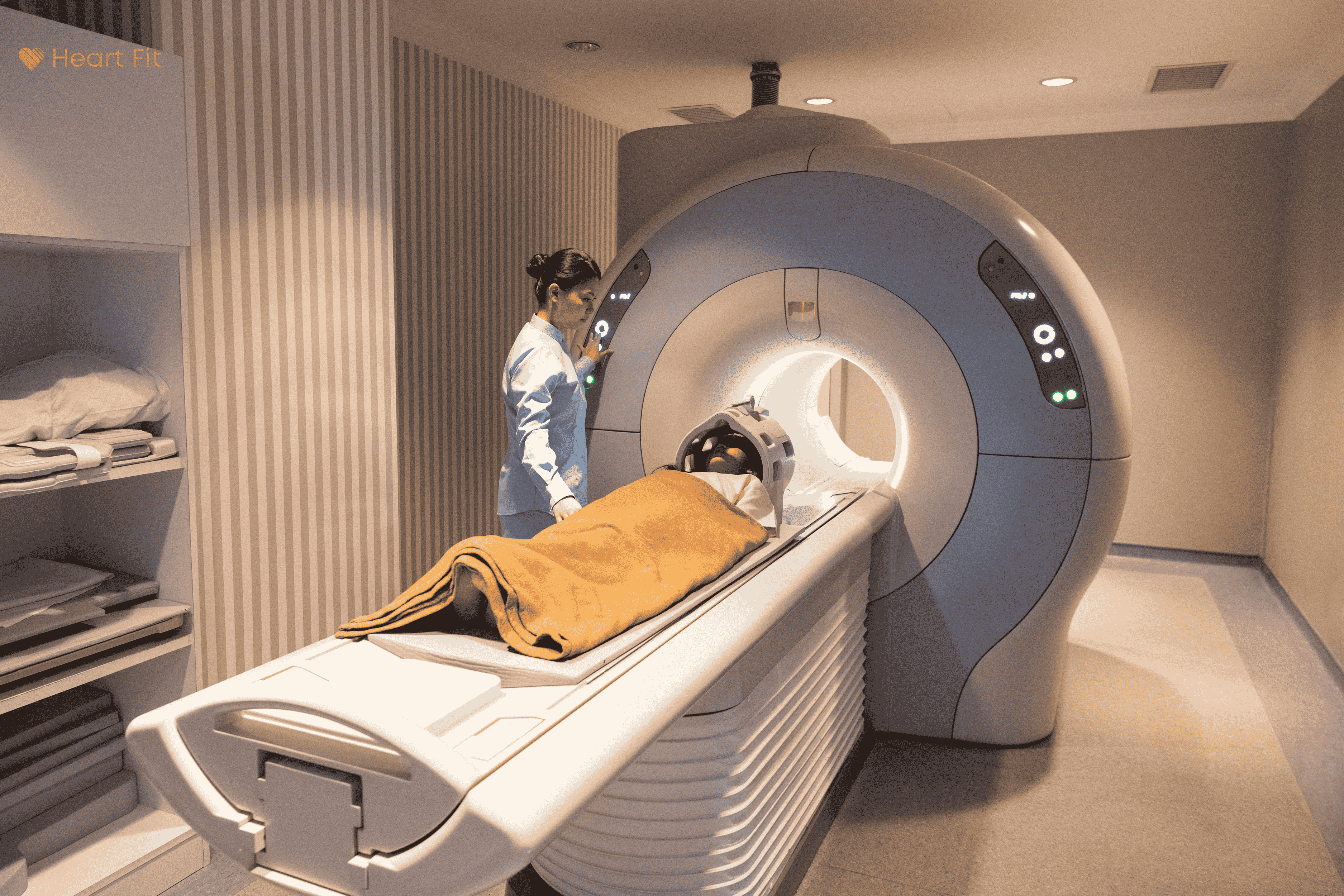
It really drives home how this differs from a traditional MRI, which usually just focuses on one specific body part.
While large-scale data on asymptomatic screening is still developing, some studies suggest potential benefits. For example, a 2021 study in the journal European Radiology found that whole-body MRI detected clinically relevant findings in a significant portion of asymptomatic individuals, though it also highlighted the challenge of incidental findings. It’s important to discuss the potential for both significant discoveries and false alarms with a healthcare provider.
The process itself is refreshingly simple. Once you're booked, the scan takes about 60 minutes. You just lie still inside the MRI machine while it captures thousands of high-resolution, cross-sectional images of your body.
Key Insight: Prenuvo isn't just a standard MRI. They use their own proprietary imaging protocols, which are specifically optimized for whole-body screening. This allows them to maximize the chances of detection across many different organ systems, all in a single session.
After your scan, a specialized radiologist goes over every image and puts together a detailed report. You typically get this within a few days, complete with images and a breakdown of any findings. From there, you can take that report to your own doctor to figure out the next steps, giving you a concrete starting point for any further investigation.
For anyone weighing their options, seeing how different services compare can be really useful. We did a deep dive on this in our article on Function Health vs Prenuvo, which helps clarify the different philosophies in the full-body screening market.
While Prenuvo scans your body's physical structure, Mito Health takes a completely different route; it dives deep into your functional health through lab-based analysis. This approach isn't about what your organs look like, but how well they're actually performing on a biochemical level. It’s a fundamental shift from spotting anatomical problems to measuring the real-time efficiency of your body's internal machinery.
The heart of the Mito Health experience is its extensive biomarker panel. Instead of a single, static picture, it gives you a dynamic view of your body's ongoing processes. This is where the Prenuvo vs. Mito Health screening difference really comes into focus. Think of Prenuvo as an architectural blueprint, while Mito is the detailed engineering report on the building's internal operations.
.png)
Biomarkers are measurable indicators of a biological state or condition. Mito Health analyzes over 100 distinct biomarkers from a simple blood draw. This comprehensive panel sheds light on critical areas of your health that imaging alone just can't see.
This granular data helps identify functional weak spots, like nutrient deficiencies or metabolic stress, that an MRI simply isn't designed to detect.
The screenshot below from Mito Health's website shows their focus on turning complex data into personalized, easy-to-understand health insights.
This visual really drives home the platform's user-friendly approach, translating complicated lab results into actionable health scores and trends.
Mito’s process is centered around comprehensive blood biomarker analysis, clinician support, and creating a personalized plan. This includes the 100+ biomarker panel, a biological age assessment, and a live 1:1 consultation with a clinician to walk you through everything. It’s a quantitative look at your internal biochemistry-hormone levels, cardiovascular risk markers, and metabolic function-that you won't get from imaging.
Key Differentiator: The one-on-one clinician consultation is a cornerstone of the Mito Health service. It transforms raw data into a personalized, actionable plan, distinguishing it from services that just hand you a report with no integrated guidance.
This follow-up is designed to put your results into the context of your lifestyle and personal goals. The clinician doesn't just point out what's suboptimal; they work with you to co-create a health optimization strategy. This highlights a core philosophical difference: Prenuvo is designed to find what is structurally wrong, while Mito aims to assess what is functionally suboptimal and give you a roadmap for improvement.
For those comparing different biomarker services, our detailed review of Function Health vs Mito Health offers more context on how these lab-based platforms stack up against each other.
When you're looking at proactive health screening, the choice between a Prenuvo scan and a Mito Health analysis boils down to a fundamental question: Are you more concerned with your body's structure or its function?
The whole Prenuvo vs. Mito Health screening discussion isn't really about which one is better overall. It’s about which tool is right for the job you’re trying to do. Prenuvo gives you an anatomical map of your body, using a powerful whole-body MRI to hunt for physical red flags like tumors or aneurysms. Mito Health, on the other hand, hands you a functional report card, using deep biomarker analysis to show how well your metabolic and cardiovascular systems are actually running.
This simple Comparison can help you see which path makes more sense for your immediate health goals.
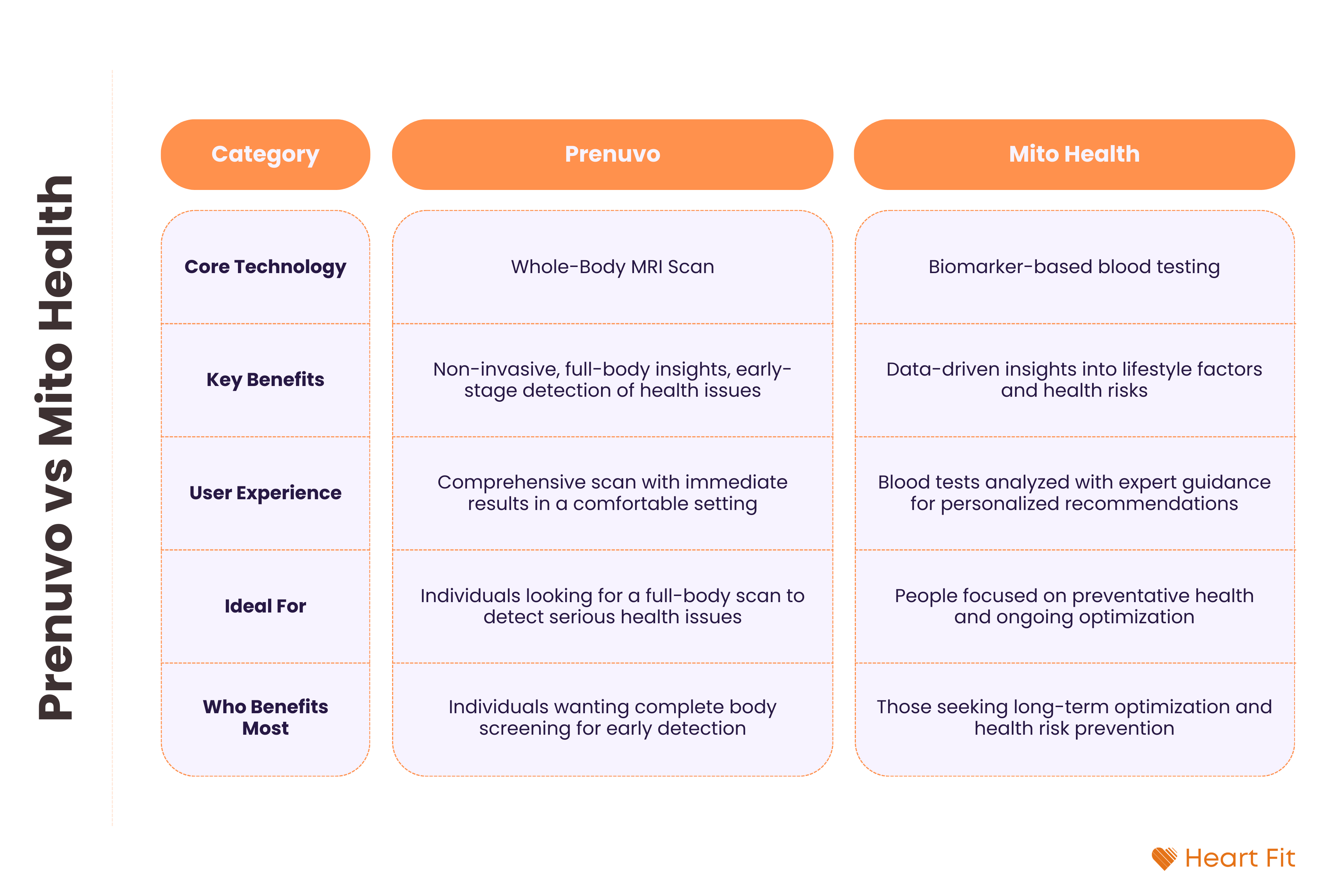
The takeaway here is pretty clear. Figure out your primary objective-finding hidden structural problems or optimizing your long-term biological performance—and the choice becomes much simpler.
The biggest distinction between the two is the technology they use. Prenuvo relies on cutting-edge Magnetic Resonance Imaging (MRI). It’s a non-invasive scan that doesn’t use any ionizing radiation, capturing thousands of high-resolution pictures of your internal organs and tissues. The entire goal is anatomical detection.
Mito Health goes in a completely different direction. They use comprehensive blood analysis to measure over 100 biomarkers. This isn't your standard physical; we're talking advanced metrics like Apolipoprotein B (ApoB). Top organizations like the American Heart Association now recognize ApoB as a much more accurate predictor of cardiovascular risk than old-school cholesterol panels. The focus is squarely on your biochemical and functional health.
Each of these screenings is really built for a different type of person and answers a different kind of question.
Key Differentiator: Prenuvo helps identify what might already be there. Mito Health reveals what might happen in the future and gives you the biochemical data to help prevent it. This is the absolute core of the Prenuvo vs Mito Health screening decision.
The experience from start to finish is also worlds apart. A Prenuvo scan means spending about 60 minutes inside an MRI machine. What you get at the end is a detailed radiologist's report, full of images and notes on any findings, which you then take to your own doctor to discuss.
Mito Health’s process starts with a simple blood draw, often at your own home or office. But the final deliverable is much more than a lab report. You get an in-depth health dashboard, a biological age assessment, and-this is crucial-a one-on-one consultation with a clinician. This expert guidance is what turns complex data into a personalized, actionable plan for your health.
To make it even clearer, let's break down the practical differences side-by-side.
This table lays out the core distinctions between Prenuvo's imaging-first approach and Mito Health's data-driven biomarker analysis.
Feature Prenuvo Mito Health Primary Focus Anatomical Structure Biochemical Function Technology Used Whole-Body MRI 100+ Biomarker Blood Panel What It Detects Solid tumors, aneurysms, cysts, degenerative changes Cardiovascular risk, insulin resistance, inflammation, hormone imbalances Final Deliverable Radiologist report with images Health dashboard, clinician consultation, and personalized action plan Best-Fit Scenario Proactive cancer screening and structural health check Longevity, performance optimization, and metabolic health management Typical Cost~$2,500~$500 annual membership + lab fees
Ultimately, one gives you a picture, and the other gives you a plan. Prenuvo's value is in its powerful imaging, offering a one-time snapshot of your body's physical state. Mito Health's value is in its continuous data analysis and expert guidance, creating a dynamic roadmap for your long-term functional health. Your personal priorities are what will decide which one is the right investment for you right now.
While these advanced health screenings open up a powerful window into our bodies, it's smart to walk in with your eyes open. Neither Prenuvo nor Mito Health is a crystal ball, and a real conversation about Prenuvo vs Mito Health screening means talking about the potential downsides of getting so much data. They’re impressive tools, but they’re not perfect, and sometimes their findings can create new problems.
The big one with whole-body imaging like Prenuvo is the risk of false positives and incidentalomas. These are harmless, clinically meaningless findings—think a tiny, benign cyst on your kidney—that pop up by chance. While they aren't actually dangerous, they can kick off a ton of worry, a feeling some people call "scanxiety."
That anxiety often spirals into a cascade of follow-up tests, from biopsies to more scans, each with its own price tag and potential risks. It’s why the American College of Radiology has long been cautious about broad screening for people without symptoms, a concern shared across much of the medical field.
The issue of false positives isn't just a hypothetical; it's a known outcome of broad imaging. A major 2019 meta-analysis published in the Journal of Magnetic Resonance Imaging looked at over 5,000 asymptomatic people who got a full-body MRI. The result? 16% of the scans flagged false positive findings, leading to unnecessary stress and follow-up procedures.
There’s another side to this, too. Experts worry that a perfectly "clean" scan might give someone a false sense of security, making them think it's okay to skip proven, essential screenings like mammograms or colonoscopies. You can get more perspective on these findings from Fortune Well.
Mito Health's deep dive into biomarkers has its own potential traps, mainly the danger of over-interpreting small fluctuations. Your body's chemistry isn't set in stone. It changes day-to-day based on what you ate, how you slept, your stress levels, and even what time you had your blood drawn.
A single biomarker that's a little outside the "optimal" range might not mean anything clinically. Without the careful eye of a qualified clinician, it's easy to start chasing numbers with restrictive diets or pricey supplements to "fix" a value that might have just returned to normal on its own. This is exactly why the guidance from Mito's team is so crucial—they help you separate the signal from the noise.
Important Disclaimer: This article is for informational purposes only and does not constitute medical advice. The information provided is not a substitute for a professional medical consultation, diagnosis, or treatment. Always seek the advice of your physician or another qualified health provider with any questions you may have regarding a medical condition.
It’s absolutely critical to remember that neither of these screenings replaces the standard, evidence-backed care your doctor recommends. Guidelines from organizations like the American Cancer Society and the U.S. Preventive Services Task Force for things like mammograms, Pap tests, and colonoscopies are built on decades of data from huge populations.
Think of Prenuvo and Mito Health as supplementary tools—powerful additions, but not replacements for the foundational care that keeps you healthy. Any findings should be discussed with your primary care doctor to figure out the right next steps for you.
Getting a detailed report from Prenuvo or Mito Health isn't the finish line—it's the starting pistol. The real win comes from using that data to make meaningful, lasting changes to your daily life. But let's be honest, turning a list of biomarkers or anatomical notes into actual habits that improve your long-term health is the hard part. That's where having a clear plan is non-negotiable.
The first, and most important, step is to sit down with your doctor. Whether it’s a structural finding from a Prenuvo scan or a few out-of-range biomarkers from Mito, your primary care physician can put those insights into the larger context of your health history. This ensures that whatever you do next is safe, effective, and grounded in solid medical advice.
The secret to lasting change is translating complex health data into simple, repeatable actions. For example, say your Mito Health report flags elevated Apolipoprotein B (ApoB), a major red flag for cardiovascular risk. Your goal isn't just to "lower a number." It’s to build habits that actually support your heart.
This means focusing on small, consistent steps you can stick with:
Key Insight: Real health progress is all about consistency, not perfection. Small, manageable habits performed daily will always beat sporadic, drastic changes over the long haul. Your screening results give you the "why," and your daily actions provide the "how."
Technology can be an incredible ally in building and sticking to healthy habits. For heart health in particular, specialized apps can turn a doctor's advice into a structured, motivating daily routine. This is where tools built for tracking and accountability really make a difference.
For anyone looking to turn their health insights into real progress, a few apps stand out:
By using a tool like HeartFit, you create a direct line from your screening results to your daily actions. It provides the structure and encouragement needed to build protective habits that last. For additional resources, you can explore information on heart-healthy diet plans at respected institutions like the Mayo Clinic.
Diving into the world of proactive health screening can bring up some very practical questions. When you're weighing options like a Prenuvo scan against a Mito Health panel, figuring out the logistics of insurance, testing frequency, and how these tools actually fit into your life is key. Let's clear up some of the most common questions.
The short answer is, probably not. Elective, proactive screenings like those from Prenuvo and Mito Health are almost always considered an out-of-pocket expense by standard health insurance plans.
The good news? You can often use funds from a Health Savings Account (HSA) or Flexible Spending Account (FSA) to cover the cost. It's always a smart move to double-check with your specific plan provider before booking anything, just to be sure you're covered and avoid any surprises.
The right rhythm for re-screening really comes down to which service you choose and what you’re trying to achieve with your health.
Absolutely not. It's crucial to see Prenuvo and Mito Health as complementary tools, not competitors. One shows you the physical structure (the MRI), while the other measures biochemical function (the biomarkers). They answer different questions about your health.
More importantly, neither of these services takes the place of your primary care physician or standard, evidence-backed screenings like colonoscopies or mammograms, as recommended by organizations like the American Cancer Society. Think of them as powerful additions to your healthcare toolkit. The real value comes from discussing any findings with your doctor to build a truly integrated and effective health plan.
Ready to turn your health data into sustainable habits? Heart Fit is an AI-powered app that transforms your bloodwork results into a simple, motivating daily action plan. Track your progress, get personalized feedback, and build the heart-healthy routines that last. Start your free trial today at https://www.heartfit.ai.
Download HeartFit.ai and start your 66-day journey today.



Join the #hearthealth crowd who are leveling up their heart health with HeartFit.ai