Everlab vs Function Health: everlab vs function health compares biomarker testing, physician guidance, and pricing to help you pick the right platform.

When you're looking at Everlab versus Function Health, the decision really boils down to one simple question: Are you looking for accessible, direct-to-consumer biomarker testing you can manage yourself, or a premium, physician-led longevity program?
Function Health is all about putting powerful data into your hands, while Everlab focuses on a high-touch, guided health optimization service. Your best fit depends entirely on that distinction.
Diving into the world of preventative health can feel overwhelming, but figuring out the core differences between platforms like these is the first step. Both Everlab and Function Health want to give you deep insights into your body's inner workings, they just go about it in fundamentally different ways.
Function Health is built for accessibility. It provides extensive biomarker testing directly to people across most of the United States. It's a fantastic choice for anyone who wants to take ownership of their health data, spot potential risks early, and then work independently (or with their own doctor) to build an action plan. Their entire model is centered on making this kind of information, which used to be hard to get, available to everyone.
On the flip side, you have Everlab, an Australian-based company offering a premium, all-in-one longevity program. They combine comprehensive bloodwork with more advanced diagnostics like DEXA scans and ECGs, and—critically—everything is interpreted and managed by a dedicated physician. This is for someone looking for a completely guided experience where a medical expert creates and oversees their health strategy from day one.
This article is for informational purposes only and is not a substitute for professional medical advice. Always consult a healthcare provider before making any changes to your lifestyle, diet, or medication.
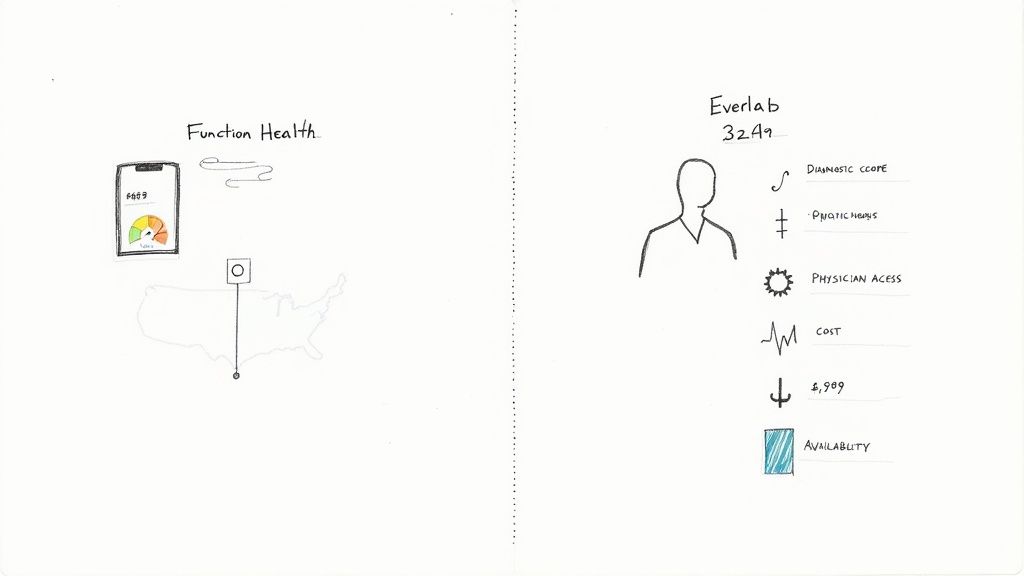
To really sharpen these differences, let's put their key features side-by-side. This quick comparison should help you see exactly how each service lines up with your personal health goals, budget, and how much medical guidance you're looking for.
This table provides a snapshot of what each service offers, making it easier to see the core differences at a glance.
Ultimately, both platforms offer valuable services, but they serve two very different needs. Your choice will depend on whether you want the raw data to steer your own ship or a dedicated captain to guide the voyage.
To really figure out which is right for you, Everlab or Function Health, you have to look beyond the feature lists and get to the heart of why each company exists. They were built on fundamentally different ideas, and that single distinction shapes everything they do—who they serve, what they offer, and how they deliver it.
Function Health is all about one thing: democratization. Their goal is to make comprehensive health data, specifically 100+ biomarkers, affordable and accessible to as many Americans as possible. The core belief here is that everyone deserves the power to look under their own hood, understand what's really going on, and take action to head off chronic illness before it starts.
This mission dictates their entire business model. By delivering your raw data along with insights reviewed by a clinician—without forcing you into a pricey, mandatory doctor consultation—they keep costs low and put you in control. It’s a “data-first” approach designed for the proactive person who wants to own their health journey.
Everlab, on the other hand, is built around the idea of guided health optimization. Their focus isn't just on lifespan, but on "healthspan"—the number of years you live in good health. Operating out of Australia, their premium service is deeply rooted in functional medicine, a practice that aims to find and fix the root cause of an issue, not just treat the symptoms.
They aren't just for people seeking data; they're for people who want a complete, hands-on program managed by a physician. Everlab’s philosophy is that deep diagnostic data is most powerful when it's interpreted and put into action by an expert who partners with you for the long haul. It's a high-touch, all-inclusive service for those who want expert guidance leading the way.
Key Takeaway: Function Health gives you the data and empowers you to act. Everlab gives you a dedicated physician who builds and manages your health plan with you.
You also can't ignore how geography shapes what each company offers. Function Health's US-based, direct-to-consumer approach is built for scale. They're trying to reach a massive, diverse market where more and more people are taking personal health into their own hands.
Everlab's localized, premium model in Australia allows for a much deeper, more integrated service, including in-person diagnostics that you can't get remotely, like DEXA scans and ECGs. Their goal isn't mass-market access; it's to provide a white-glove experience for clients who are ready to invest significantly in expert-led preventative care. According to the World Health Organization, preventative care is essential for tackling the global rise in chronic diseases, a mission both companies approach from very different angles.
Grasping this fundamental split—data for the masses versus guided optimization for the few—is the key to making the right choice. It explains everything from their pricing and features to their support models, helping you match your personal goals with the service that was actually built for them.
Any service can throw around a big number like "100+ biomarkers," but the real story isn't just how many markers they test. It’s about what they test and how they test it. This is where Everlab and Function Health really start to diverge. While both give you an incredibly detailed look under the hood with your bloodwork, their diagnostic tools and ultimate goals paint two very different pictures of your health.
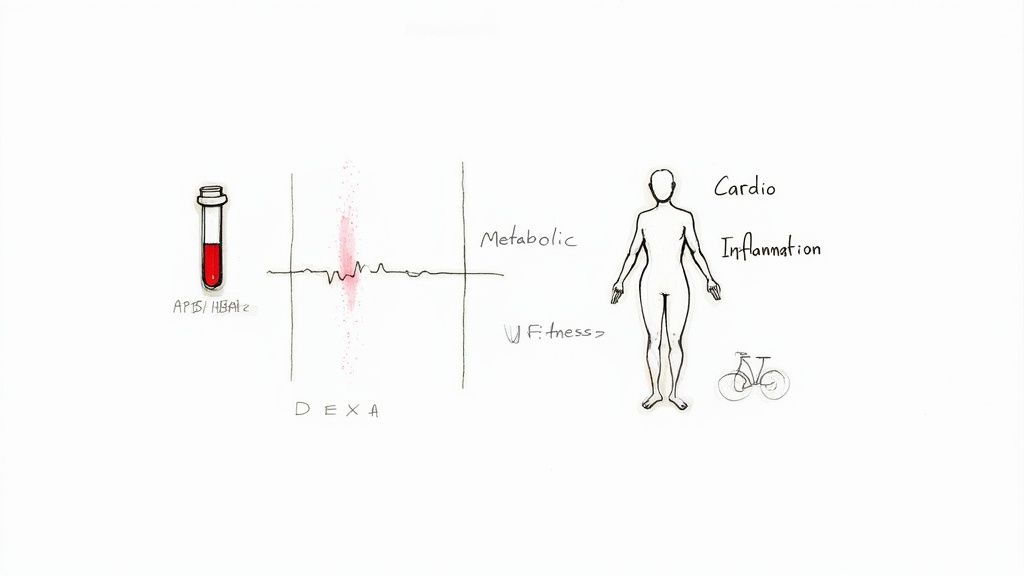
Function Health is fantastic at one thing in particular: delivering a comprehensive, easy-to-understand blood panel that covers a huge range of health markers. Their tests are specifically geared toward catching the earliest warning signs of metabolic problems and cardiovascular disease, putting complex biochemical data into the hands of the average person.
Thankfully, both services cover the non-negotiables you'd want for a solid health baseline. This common ground is critical for identifying risks tied to heart disease, diabetes, and chronic inflammation.
While this shared foundation is great, the real difference between Everlab and Function Health shows up when you look beyond the blood draw. For a more detailed look, you can see our complete guide on the full Function Health biomarkers list.
This is where Everlab really breaks away from the pack. Their program isn't just about what's in your blood; it's a multi-layered assessment that pulls in physical and functional tests to build a far more complete profile of your healthspan. This approach gives you crucial data points that bloodwork alone just can't provide.
A key differentiator in the Everlab vs Function Health showdown is biomarker depth and longevity focus. Both test 100+ markers including critical ones like ApoB and Lp(a), but Everlab elevates this with multimodal assessments like DEXA for bone density, ECG for arrhythmias, and VO2 max for cardiovascular fitness, which predicts mortality risk better than traditional factors.
This integrated model isn't just designed to find disease risk. It's built to quantify your body's real-world functional capacity and resilience right now.
A DEXA scan is the gold standard for measuring bone mineral density. It can spot early signs of osteoporosis—a condition where bones become brittle and prone to fracture. It also provides a precise breakdown of your body composition, detailing fat mass versus lean muscle.
An ECG is a non-invasive test that records the electrical signals of your heart. It's essential for detecting abnormal heart rhythms, known as arrhythmias, which can be silent but may lead to serious issues like stroke.
Often cited as a powerful predictor of longevity, a VO2 max test measures the maximum amount of oxygen your body can utilize during intense exercise. As a 2016 American Heart Association scientific statement emphasized, higher cardiorespiratory fitness is strongly correlated with a lower risk of mortality from all causes. This test provides a hard number for your cardiovascular engine's true capacity.
In short, Function Health gives you a remarkably detailed map of your body's biochemistry. But Everlab’s addition of DEXA, ECG, and VO2 max testing provides a physical, functional report card, offering a much more holistic view of your current health and longevity potential. Your choice really comes down to whether you want to focus on deep biochemical data or get a broader, multi-system health evaluation.
Collecting health data is just the first step. The real value comes from turning those complex numbers into a clear, personalized action plan. This is where Everlab and Function Health diverge the most. One hands you the information, while the other gives you a dedicated medical partner to co-pilot your entire health journey.
This difference in the Everlab vs Function Health comparison is everything. It shapes your experience, the support you get, and who is accountable for making changes. The choice really boils down to whether you prefer self-directed discovery or expert-led management.
Function Health does a great job of taking complex biomarker data and making it digestible. Once your lab results are ready, they pop up in your personal dashboard with simple explanations and visuals.
Each biomarker is categorized, flagged if it’s outside the optimal range, and paired with insights reviewed by a clinician. It’s designed to teach you what each marker means—for instance, explaining that high LDL cholesterol is the "bad" kind that can lead to plaque in your arteries, a risk factor the American Heart Association stresses the importance of managing.
The platform then gives you a detailed "Action Plan" with general recommendations for diet, supplements, and lifestyle tweaks based on your results. For a closer look at what users think of these plans, you can check out these in-depth Function Health customer reviews. It's important to remember, though, that this is an informational starting point.
Key Differentiator: Function Health's model is built on empowerment through information. It gives you the "what" and the "why," but the "how" is largely on you or your personal doctor to figure out and implement.
Making these health plans work often means getting specific about diet. A good guide to understanding macros for weight loss is the kind of practical knowledge Function Health users often need to put their nutritional advice into practice.
Everlab takes a completely different path. Here, data interpretation and action planning are led by a physician from start to finish. Your results aren't just uploaded to a dashboard for you to sort through; they're analyzed by your dedicated doctor who then walks you through them in a one-on-one consultation.
This high-touch approach turns raw data into a truly bespoke health strategy. Your Everlab physician doesn't just explain your lab numbers; they build a comprehensive plan that weaves together your biomarkers, lifestyle, genetics, and personal health goals.
This direct doctor-patient interaction allows for a much deeper level of personalization and clinical oversight.
This model is less about simply delivering data and more about providing a continuous, medically supervised health management service. The plan isn't just a list of suggestions; it's a clinically directed protocol managed by an expert who is there to guide your progress.
In short, Function Health equips you with a map, while Everlab provides a personal guide for the entire journey.
When you put Everlab and Function Health side-by-side, the price is the first thing that jumps out. We're talking a massive difference: $499 a year for Function Health versus a hefty $2,999 for Everlab. But looking at just the sticker price doesn't tell the whole story.
To really get it, you have to ask what you're actually buying. Is it just the raw data from a comprehensive lab panel, or is it a complete, doctor-managed health program? That's the core question, and the answer is key to figuring out which one offers the right value for you.

This image nails the trade-off perfectly. Function Health gives you incredible lab testing for a very accessible price. Everlab, on the other hand, is a premium investment for an all-in-one diagnostic and medical service. Each serves a totally different need and budget.
Function Health's $499 annual membership is all about making advanced health data available to more people. The main draw is the incredible amount of information you get for that price. If you tried to order a similar panel of over 100 biomarkers from a traditional lab, you'd be looking at a bill well over $1,000.
What makes it even more appealing is that the cost is often eligible for HSA/FSA (Health Savings Account/Flexible Spending Account) funds. For many people, this means paying with pre-tax money, which sweetens the deal even more. For a complete rundown on the financials, check out our guide to the Function Health membership cost.
The value here is simple and powerful: Function Health is making proactive health monitoring affordable for almost everyone.
Everlab's $2,999 price tag positions it as a full-blown, physician-led longevity program, not just a testing service. To see the value, you have to break down what's actually included in that price, because these are services that add up quickly on their own.
Let's do the math on the individual components:
When you start adding these up, the total value quickly gets close to—or even goes beyond—the $2,999 price. And that's not even counting the convenience of having everything managed and interpreted by a single, dedicated medical team.
With Everlab, you aren't just buying tests. You're investing in a concierge medical service that pairs advanced diagnostics with ongoing, expert clinical guidance. The real value is in the integration and continuous access to a physician.
Ultimately, deciding which offers "better value" comes down to your personal goals. If you're looking for affordable, comprehensive data that you can act on yourself, Function Health is a clear winner. But if you want a complete, guided health optimization program with a doctor in your corner every step of the way, Everlab provides a compelling, all-in-one package.
Picking between Everlab and Function Health isn't just about comparing features. It’s about figuring out what you actually need and want from a health service. To cut through the noise, I've broken it down into a few practical scenarios to help you see which platform is the better fit for different people.
Think of this as the final gut check in the Everlab vs Function Health decision. It moves beyond a simple pros and cons list to give you clear, straightforward advice based on who you are.
The Clear Choice: Function Health
If you're proactive, love digging into data, and feel comfortable steering your own health ship, Function Health is likely your best bet. You want those deep biomarker insights to get ahead of potential issues, but you need an affordable way in. At $499 a year (especially with HSA/FSA eligibility), it hits that sweet spot.
Function Health delivers exactly what this person values most: raw data. You get a clinician-reviewed action plan that you can either take to your own doctor or use as a guide for your own research into diet and lifestyle tweaks. It hands you the information without the premium price tag of a dedicated physician service.
Real-World Example: Imagine a 35-year-old who's serious about fitness. They want to keep a close eye on their metabolic health and key cardiovascular risk markers like ApoB. They're confident they can take that data, understand it, and work with their primary care doctor on any needed changes. Function Health gives them the exact lab results they're after, at a price that makes sense.
The Clear Choice: Everlab
This is for the busy professional who sees their health as a critical investment and wants an expert to manage the entire process. Time is their most valuable asset. They're not just looking for a spreadsheet of numbers; they're paying for a premium, physician-led service to maximize their healthspan. The $2,999 price tag is an investment in a comprehensive, fully managed program.
Everlab's entire model is built for this person. The service goes beyond bloodwork, incorporating advanced diagnostics like DEXA scans and VO2 max testing, and pairs it all with direct, one-on-one time with a physician. It's a high-touch approach where the doctor does the heavy lifting—analyzing the results, creating a truly personalized plan (prescriptions and all), and providing ongoing guidance. This leaves you free to simply execute the plan.
A quick reminder: this article is for informational purposes only. You should always consult with a qualified healthcare provider before making any changes to your health routine or starting a new treatment.
No matter which service you land on, the report is only as good as the action you take. This is where the rubber meets the road, and habit-tracking apps become your best friend for turning those recommendations into real, lasting change.
Here are some of the best apps to help you stay on track:
By linking the diagnostic data from Everlab or Function Health to a daily-use app like HeartFit, you close the loop. You get the high-level strategy from the tests and the day-to-day accountability you need to actually follow through.
When you're digging into the details of a health service, a few practical questions always come up. Here are some clear, straightforward answers to the most common queries about Everlab and Function Health, which should help you lock in your decision.
First, here's a quick decision tree to help you visualize which path might be a better fit based on what you're trying to achieve.
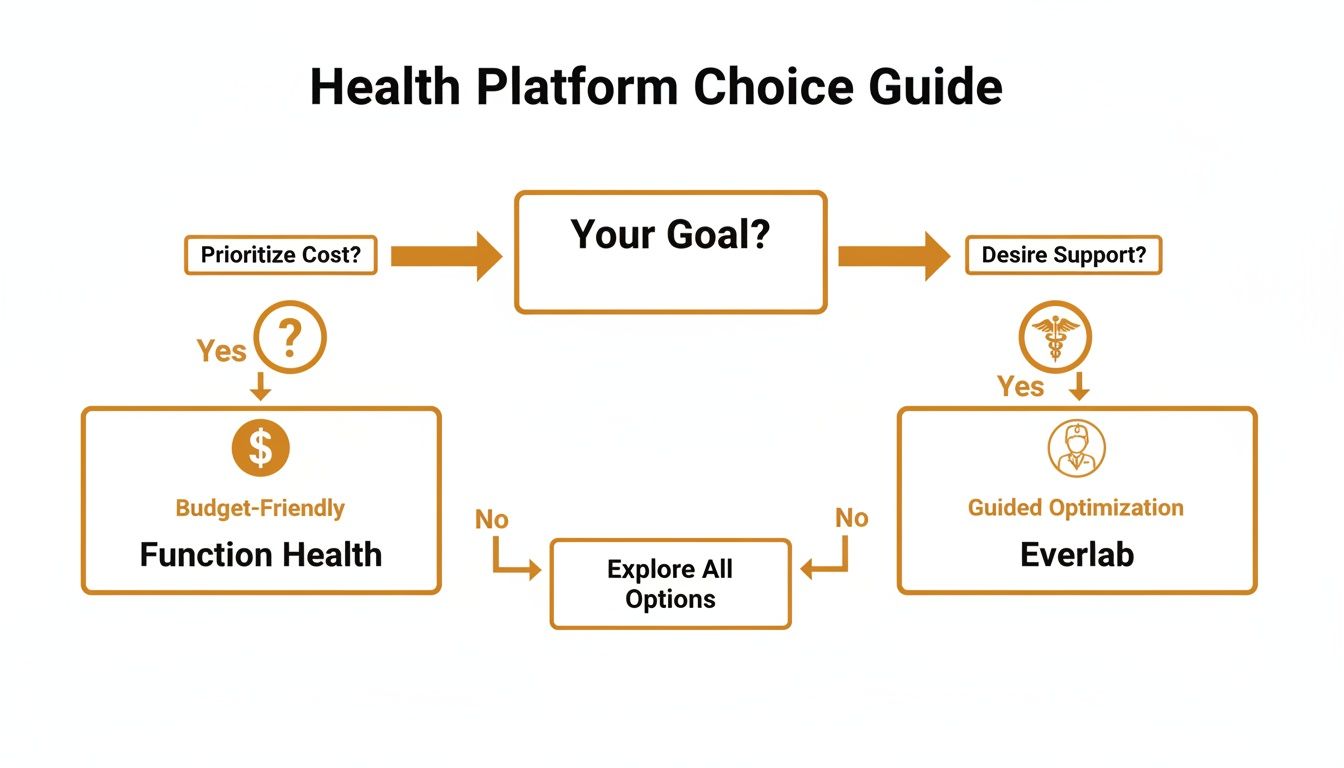
It really boils down to your main objective. If your top priority is getting comprehensive data at an accessible price point, Function Health is the logical place to start. But if your goal is expert-led optimization with a doctor in your corner, Everlab is built for that.
This is a big one, and the answer is quite different for each platform.
Function Health is set up with the US healthcare system in mind. While it's not covered by standard health insurance, many members can use pre-tax funds from a Health Savings Account (HSA) or Flexible Spending Account (FSA) to pay for the $499 annual membership.
Everlab, on the other hand, operates in Australia under a private-pay model. Its premium, physician-led program is a direct investment in your health and is not typically covered by standard insurance or Medicare. It’s an out-of-pocket expense for a deeply comprehensive, preventative service.
The testing cadence really gets to the heart of each service's philosophy—one is about getting a great annual snapshot, while the other is focused on continuous, guided improvement.
Finding a critical health issue is a real concern, and both services have protocols for it, though their approaches to follow-up care differ.
With Function Health, the process is designed to get urgent information to you quickly. If a result is critically abnormal, their clinical team will contact you and strongly recommend you see your primary care physician for immediate diagnosis and care. The responsibility to arrange that next step is yours.
Everlab’s model offers a more integrated response. Since you’re already under the care of a physician, they can act on critical findings directly. This might mean prescribing medication, ordering more diagnostic tests, or giving you an immediate referral to a specialist in their network, making for a much smoother transition to the next stage of care.
Disclaimer: The information in this article is for educational purposes only and should not be considered medical advice. Always consult with a qualified healthcare provider for any health concerns or before making any changes to your diet, lifestyle, or medical regimen.
Ready to turn your health data into daily action? Heart Fit helps you build sustainable habits based on your biomarker results. Paste your action plan, track your progress with gamified tasks, and get AI-powered feedback to stay on track. Start your free trial today at https://www.heartfit.ai.
Download HeartFit.ai and start your 66-day journey today.



Join the #hearthealth crowd who are leveling up their heart health with HeartFit.ai