Our comprehensive Biograph vs Prenuvo guide breaks down the technology, cost, safety, and use cases to help you make an informed health decision.
At their core, the difference between a Biograph scan and a Prenuvo scan comes down to a simple question of purpose.
Biograph PET/CT systems are diagnostic tools used by doctors to investigate a specific, known health concern. In contrast, Prenuvo is a proactive screening service for people who feel perfectly fine and want a look under the hood.
So, the right choice really hinges on whether you need a doctor-ordered test for a suspected condition (Biograph) or you're choosing a self-directed scan to get a general overview of your health (Prenuvo). This article is for informational purposes only and is not a substitute for professional medical advice. Always consult with a qualified healthcare provider before making any decisions about your health or treatment.
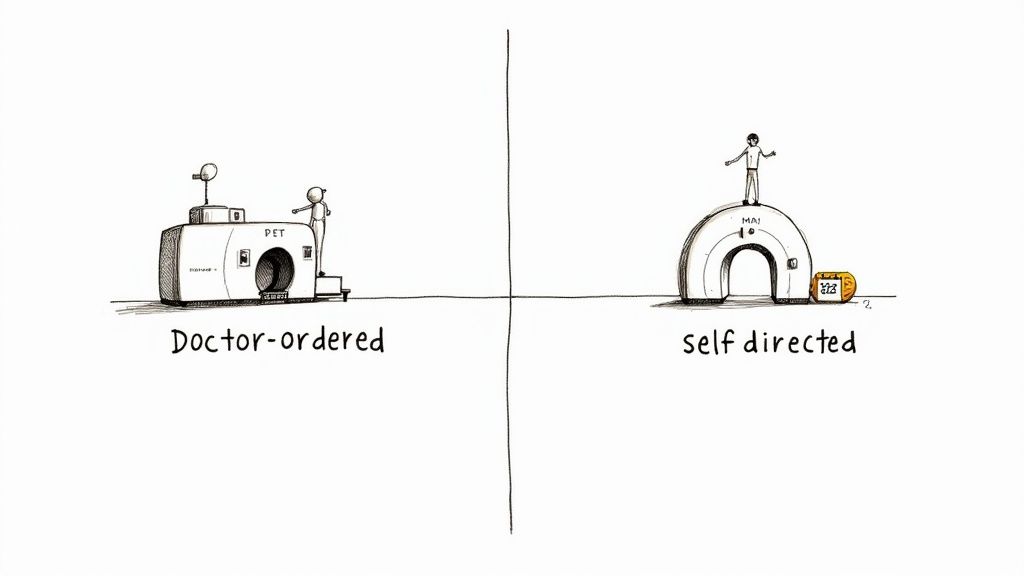
When you hear names like Biograph and Prenuvo, it’s easy to get them mixed up. But they represent two completely different philosophies in medical imaging. It’s not about one being better than the other; it’s about using the right tool for the right job. Getting a handle on their fundamental differences is the first step toward having an informed conversation with your doctor.
A Siemens Biograph system is a powerful clinical workhorse that combines two technologies: Positron Emission Tomography (PET) and Computed Tomography (CT). A doctor will order a PET/CT scan to get a very specific answer, such as:
Prenuvo, on the other hand, is a direct-to-consumer service built on radiation-free Magnetic Resonance Imaging (MRI). People proactively book these scans themselves to get a comprehensive picture of their internal health, hoping to catch potential issues like tumors or aneurysms long before symptoms appear.
These two approaches exist in different parts of the healthcare world. Biograph systems are staples in hospitals and a key driver of the multi-billion dollar oncology imaging market. You can explore more about the biotechnology industry on ibisworld.com. Prenuvo operates in the growing consumer wellness space, catering to individuals focused on early detection.
This table really helps clarify the head-to-head distinctions.
As you can see, they are designed for fundamentally different scenarios—one reactive and diagnostic, the other proactive and preventative.
Disclaimer: This article is for informational purposes only and is not a substitute for professional medical advice. Always consult with a qualified healthcare provider before making any decisions about your health or treatment.
To really get to the bottom of the Biograph vs. Prenuvo debate, you have to start with the fundamental science. These are not interchangeable scans; they’re designed from the ground up to find completely different things inside your body.
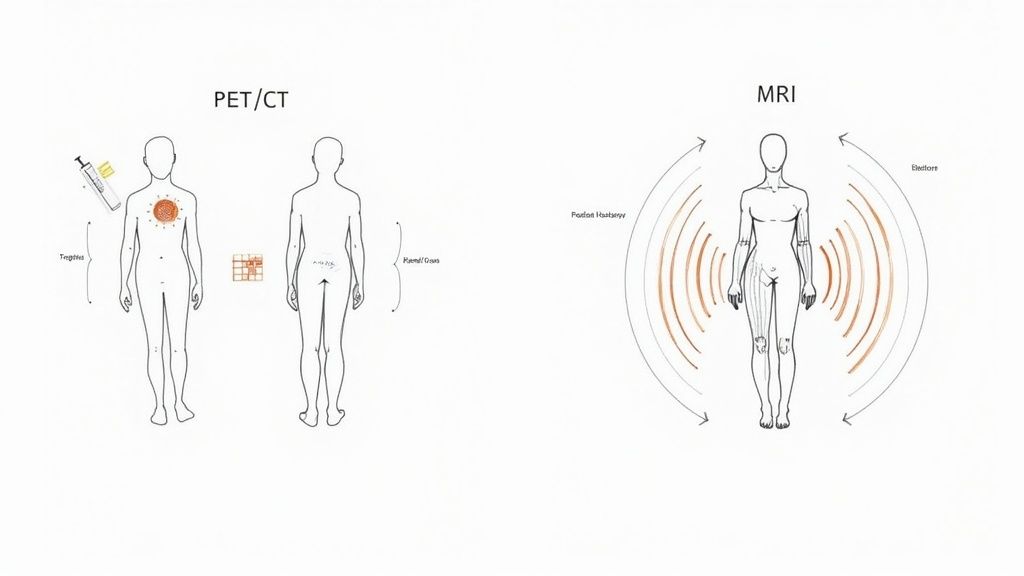
This isn’t a small distinction—it’s everything. Understanding the fundamental differences between CT scans and MRI technology is the best place to start, as these two methods are the building blocks for the systems we're discussing.
Siemens Biograph systems are incredibly sophisticated tools, essentially fusing two powerful imaging types into a single, comprehensive scan: Positron Emission Tomography (PET) and Computed Tomography (CT). Think of it as getting two distinct layers of information in one go.
The PET scan is all about function. Before your scan, a safe, radioactive tracer gets injected. This tracer is engineered to be snapped up by cells with unusually high metabolic activity.
Key Insight: Cancer cells, for instance, are notoriously energy-hungry. As documented in numerous studies available on PubMed, they burn through glucose way faster than healthy cells. The tracer, which is attached to a sugar molecule, collects in these hotspots and makes them "light up" on the PET image.
Then comes the CT scan, which provides the second layer: anatomy. It uses X-rays to create a detailed 3D map of your organs, bones, and other tissues. When the two images are merged, a doctor sees not just that there's a suspicious area of high activity, but precisely where it is located.
Prenuvo takes a completely different route, relying on Magnetic Resonance Imaging (MRI). The single biggest difference here is that MRI uses zero ionizing radiation. Instead, it uses a powerful magnetic field and radio waves to generate stunningly detailed pictures.
Here’s how it works: the magnetic field aligns the water molecules in your body. Radio waves then briefly knock them out of alignment. As these molecules snap back into place, they send out signals that a computer translates into incredibly clear cross-sectional images.
This makes MRI exceptional at visualizing soft tissues. It gives you a crystal-clear look at the structure and form of your organs, muscles, brain, and joints. Its strength is in spotting structural abnormalities—things like solid tumors, cysts, aneurysms, or inflammation. It's not designed to measure metabolic function like a PET/CT, but it provides an unparalleled anatomical blueprint. If you're weighing different MRI-based services, our deep dive on Prenuvo vs Fountain Life offers more context.
The biggest difference between Biograph and Prenuvo isn't the technology—it's the reason you'd get one in the first place. One is a highly focused diagnostic tool used to answer very specific medical questions, while the other is a broad screening tool designed for proactive health discovery.
Think of it like this: a Biograph PET/CT is what your doctor orders when they already suspect something is wrong. A Prenuvo scan is what you choose when you want to look for potential issues before symptoms ever appear.
A Biograph PET/CT scan is a heavyweight in modern diagnostics. Physicians turn to it when there's a clear clinical question that needs answering, especially in oncology, as institutions like the National Cancer Institute (NCI) highlight.
Doctors rely on PET/CT scans for several critical tasks:
But its use isn't limited to cancer. In cardiology, a PET/CT can assess the health and viability of heart muscle, which is crucial after a heart attack. Neurologists also use it to evaluate brain disorders like dementia by mapping patterns of metabolic activity.
This image from the National Cancer Institute gives a clear picture of what a PET scan does. It lights up areas of high metabolic activity, which often signals the presence of cancerous cells.
Those bright spots are where the radioactive tracer has collected, essentially giving doctors a map of tissues that are working overtime—and that require a much closer look.
Prenuvo, on the other hand, is built for a completely different purpose: proactive screening for people who feel perfectly healthy. The goal is to get a comprehensive baseline of your health by searching for a wide range of potential problems before they become serious.
The scan looks for things like solid tumors, aneurysms, cysts, and other structural abnormalities that might otherwise go unnoticed for years. Understanding the challenges of undetected lung cancer really drives home the potential value of catching things early.
If you're exploring similar MRI-based screening options, our detailed comparison of Prenuvo versus other health screenings offers more context on the different players in this space.
The core distinction is simple: A Biograph PET/CT is a reactive diagnostic tool used to investigate known or suspected problems. A Prenuvo MRI is a proactive discovery tool used to search for unknown ones.
You just wouldn't get a PET/CT scan to "check in" on your health. It's a powerful, targeted procedure reserved for specific medical situations under a doctor's orders. A Prenuvo scan is an elective choice for anyone wanting a broad overview of their anatomical health, fully aware that it might uncover incidental issues that need follow-up.
Disclaimer: This article is for informational purposes only and is not a substitute for professional medical advice. Always consult with a qualified healthcare provider before making any decisions about your health or treatment.
When you get down to it, one of the sharpest contrasts between Biograph and Prenuvo is radiation. For many people, this single factor—along with the overall experience of the scan—becomes the tipping point in their decision.
A Biograph PET/CT scan uses a carefully controlled dose of ionizing radiation. It’s a two-part process: you get a low-dose CT scan for the anatomical blueprint, and an injectable radiotracer for the PET scan, which lights up metabolic hotspots in the body.
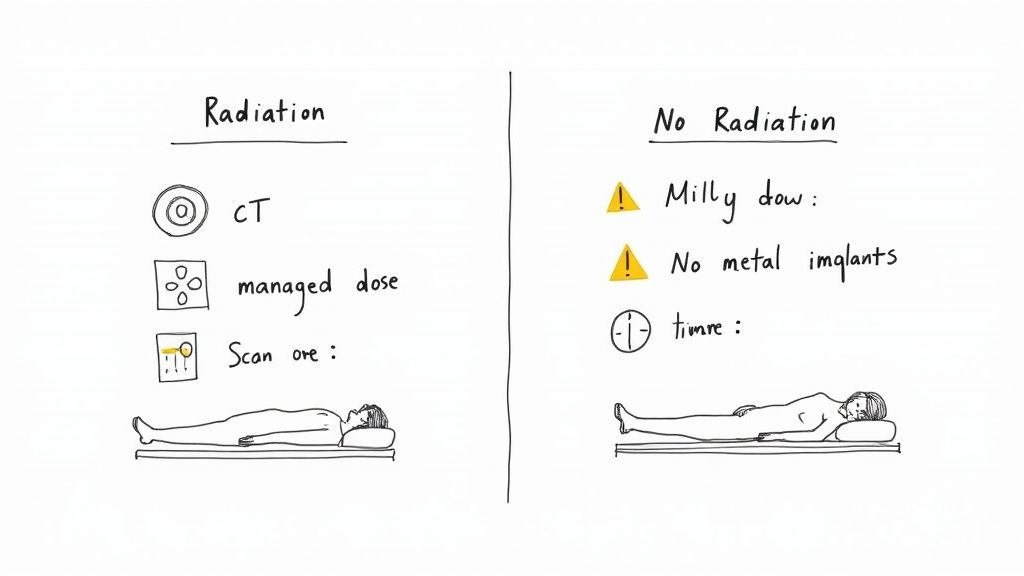
This simple sketch really nails the fundamental difference. PET/CT is a calculated medical tool involving radiation, while MRI is radiation-free but has its own rules, like avoiding metal.
It’s completely normal to be cautious about radiation. But it’s crucial to understand that when a doctor orders a PET/CT, they've already weighed the scales and concluded that the diagnostic information they'll gain is far more valuable than the low-level risk.
According to the Centers for Disease Control and Prevention (CDC), doctors prescribe imaging only when it's essential for diagnosis or treatment. The goal is always to get a crystal-clear image using the absolute minimum amount of radiation necessary.
On the flip side, Prenuvo's whole-body MRI is completely radiation-free. This is a massive plus for a proactive screening tool, especially if you're thinking about getting repeat scans over the years as part of a long-term health monitoring plan.
The key takeaway is that medical scans are just one piece of the radiation puzzle. Their immense diagnostic power often justifies the exposure, but it's a conversation worth having with your doctor.
What's it actually like to get one of these scans? The experience, from prep to the time spent inside the machine, is quite different.
Preparation and Scan Duration:
Contraindications:
There's another critical dividing line: contraindications. Because MRI uses powerful magnets, it's a no-go for anyone with certain metal implants like pacemakers, cochlear implants, or older surgical clips. A PET/CT doesn't have these magnetic restrictions, making it the default choice for those patients.
Disclaimer: This article is for informational purposes only and is not a substitute for professional medical advice. Always consult with a qualified healthcare provider before making any decisions about your health or treatment.
The way you get a Biograph PET/CT scan versus a Prenuvo MRI couldn't be more different. These pathways really highlight their core purposes: one is a tool within the traditional medical system, ordered out of necessity, while the other is a direct-to-consumer wellness service you choose for yourself.
A Biograph PET/CT is a serious diagnostic procedure. You can't just decide you want one. It requires a doctor's referral, typically ordered to get to the bottom of specific symptoms or to track a known condition like cancer. It’s a medically necessary test, plain and simple.
Because a doctor prescribes it, insurance will usually cover a PET/CT. Of course, you might still have some out-of-pocket costs from your deductible or copay. The entire process, from referral to results, is managed within the healthcare system.
Prenuvo flips that model on its head. It’s a direct-to-consumer service, which means you can go online and book a scan on your own, no doctor's note needed. This is for people who want a proactive, comprehensive look at their health, not for those trying to diagnose an existing problem.
The big difference here is the cost. Prenuvo scans are almost never covered by insurance. You're paying the full price out-of-pocket, which can run several thousand dollars. It’s positioned as a personal investment in your health, much like other high-end wellness services. We dive deeper into how Prenuvo compares to other wellness-focused options in our guide on Function Health vs Prenuvo.
Key Takeaway: The choice between Biograph and Prenuvo often boils down to access. One requires a doctor’s order and insurance approval for a specific medical reason. The other is a self-funded, elective choice for general health screening.
The entire journey for a patient—from booking the scan to understanding what it found—is also worlds apart. Looking at the practical side of things really brings the financial and logistical differences into focus.
Here’s a quick breakdown of what to expect from each.
So, what does this all mean? The Biograph process is physician-led from start to finish, with the results feeding directly into your ongoing medical care. The Prenuvo experience, on the other hand, is consumer-led. It gives you a wealth of data that you then need to bring back into the traditional medical system if any action is needed.
Disclaimer: This article is for informational purposes only and is not a substitute for professional medical advice. Always consult with a qualified healthcare provider before making any decisions about your health or treatment.
Deciding between a Biograph PET/CT and a Prenuvo MRI isn't about picking a "better" technology. It's about choosing the right tool for the job. The entire decision boils down to one simple question: Are you investigating a problem you already know about, or are you searching for one you don't?
This decision should always be a conversation with a healthcare provider who knows your full medical history and can help you weigh the options.
The way you get to each scan is usually quite different, as this flowchart shows.
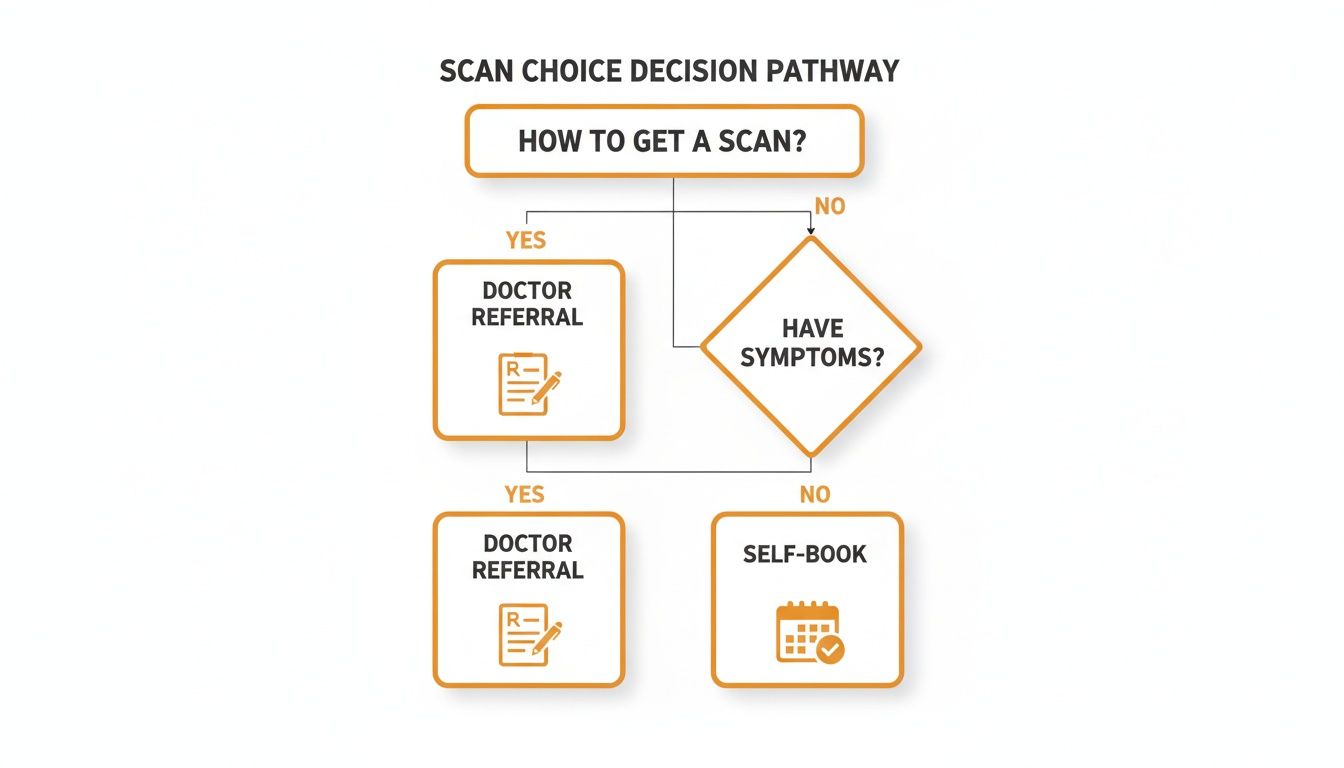
As you can see, the path to a PET/CT almost always starts with a doctor's referral for a specific medical reason. Getting a whole-body MRI, on the other hand, is often a choice you make on your own.
The right path forward becomes much clearer once you know what you're trying to accomplish. Let your current health status and your ultimate goal be your guide.
Crucial Reminder: A proactive scan like this is not a substitute for standard, proven screenings like mammograms or colonoscopies. The American College of Radiology is clear that established screening methods are still the gold standard for detecting specific diseases where they have a long track record of success.
Ultimately, getting the scan is just the first step. The real value is in what you and your doctors do with the results. Integrating these findings into a complete health plan is key. For any heart-related discoveries, using a tool like one of these habit tracking apps can help you turn that data into actionable daily habits:
Disclaimer: This article is for informational purposes only and is not a substitute for professional medical advice. Always consult with a qualified healthcare provider before making any decisions about your health or treatment.
Let's tackle a few of the most common questions people have when weighing these two very different technologies.
No, absolutely not. It's crucial to understand that a Prenuvo MRI is a proactive screening tool, while a PET/CT is a powerful diagnostic one. They operate in completely different realms.
Think of it this way: a PET/CT provides unique metabolic information that's essential for diagnosing, staging, and tracking diseases like cancer. An MRI, while fantastic for showing detailed anatomy, simply can't provide that functional data. They serve entirely different clinical purposes and are not interchangeable.
First, don't panic. If your Prenuvo scan flags a potential abnormality, the report will suggest the next steps, which will always point you back to a physician. A finding like this isn't a diagnosis—it's the start of a proper diagnostic journey.
Your doctor will review the findings and likely order more specific, targeted tests to get a clearer picture. This could be anything from an ultrasound or a biopsy to a formal diagnostic scan to confirm what the finding is and figure out the right course of action.
It's a valid question. While PET/CT scans do use ionizing radiation, medical experts are extremely careful about managing the dose. Your doctor only orders this type of scan when the diagnostic benefit is clear and far outweighs the potential risk.
Respected bodies like the American College of Radiology consider the risk from a single, medically necessary scan to be low. You should always feel comfortable discussing any worries about radiation with your doctor. They can explain the specific context for your situation and why they believe it's the best path forward for your health.
Integrating insights from any advanced scan requires a proactive approach to daily health. HeartFit helps you turn your health data into sustainable habits. Track nutrition, monitor progress, and build a heart-healthy lifestyle with AI-powered guidance. Start your journey at https://www.heartfit.ai.
Download HeartFit.ai and start your 66-day journey today.



Join the #hearthealth crowd who are leveling up their heart health with HeartFit.ai