Searching for what supplements does andrew huberman recommend? Our guide covers his key recommendations for sleep, focus, and hormones, with cited sources.

Disclaimer: This article is for informational purposes only and is not a substitute for professional medical advice. Always consult with a qualified healthcare provider before starting any new supplement or making changes to your lifestyle or medication regimen. The information presented here is not intended to diagnose, treat, cure, or prevent any disease.
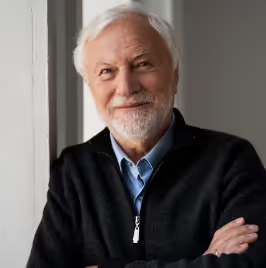
Andrew Huberman, a neuroscientist and professor at Stanford University, frequently discusses dietary supplements for optimizing health and performance. This article provides a detailed list of the supplements he uses or has discussed, complete with dosages and context based on his public statements.
This post was last updated in September 2024.
Huberman’s complete supplement stack, including daily, occasional, previous, and sleep supplements
In a June 2024 interview with Dr. Rhonda Patrick, Andrew Huberman detailed his daily supplement regimen. We will start with the supplements he takes to help optimize his testosterone levels. Testosterone is crucial for both men and women; in females, it serves as a precursor to estrogen.
Tongkat Ali is derived from a plant native to Southeast Asia. Huberman explains that he takes 400 mg of Tongkat Ali each morning to increase his testosterone.
This is supported by a 2022 meta-analysis published in Andrologia, which reviewed five randomized controlled trials and concluded that Tongkat Ali supplementation (at doses from 100 mg to 600 mg) significantly increased total testosterone levels compared to a placebo.
Huberman suggests:
When asked by Tim Ferriss which two supplements he would choose between Tongkat Ali, Fadogia Agrestis, Omega-3s, and Rhodiola Rosea, Huberman selected Tongkat Ali and Omega-3s. He noted that after starting Tongkat Ali and Fadogia Agrestis, his total testosterone increased from around 600 ng/dL to the high 700s/low 800s.
Huberman’s Dose: 400mg per day
Fadogia Agrestis is a plant native to Nigeria. Huberman explains that it works by increasing Luteinizing Hormone (LH), which stimulates the testes to produce more testosterone.
He takes 600 mg per day, cycling it for 8-12 weeks at a time, followed by a few weeks off. This cycling approach is a precaution based on a rat study that found high doses could disrupt liver and kidney enzymes. Huberman notes he monitors his bloodwork regularly and has not observed any negative impacts.
Dr. Kyle Gillett's Dosing Regimens
In an interview with Huberman, Dr. Kyle Gillett suggested cautious dosing for those not getting regular blood work:
For those monitoring blood markers, a more aggressive approach can be 600 mg daily for a month, followed by 1–2 weeks off.
Huberman’s Dose: 600 mg per day, cycled
Huberman takes Zinc, referencing a 2020 paper in the Expert Review of Endocrinology & Metabolism that linked deficiencies in zinc, magnesium, and vitamin D to lower testosterone levels.
Zinc is essential for producing Luteinizing Hormone (LH) and Follicle-Stimulating Hormone (FSH), which are critical for testosterone production in both men and women. However, it's important to note that supplementing with zinc will only boost testosterone if you are deficient; excess zinc will not provide additional benefits.
Dose: Huberman hasn't specified his exact dose, but the multivitamin he takes contains 15 mg of zinc. The National Institutes of Health (NIH) recommends a daily intake of 11 mg for men and 8 mg for women, with a tolerable upper intake level of 40 mg for adults.
Boron is a trace mineral found in many foods. Huberman mentions taking 2–4 mg of Boron daily. Dr. Kyle Gillett has suggested that Boron may help lower Sex Hormone-Binding Globulin (SHBG), thereby increasing the amount of "free" testosterone available for the body to use.
The NIH suggests an "acceptable safe range" for boron intake for adults is 1–13 mg/day.
Huberman's Dose: 2–4 mg per day
Huberman has stated he takes a daily multivitamin, specifically Opti-Men by Optimum Nutrition, a habit he has maintained for about 25 years. He notes that while this is more a result of habit than recent research, his regular blood tests show no adverse effects.
Huberman emphasizes that fats are a crucial component of the brain, which is composed of 60% fat. He notes that while most people consume enough omega-6 fatty acids, many are deficient in omega-3s.
He recommends everyone aim for at least 1 gram of EPA (eicosapentaenoic acid), a type of omega-3, per day. Huberman personally aims for 2-3 grams of EPA daily through fish oil supplements since he rarely eats fish.
How to Choose an Omega-3 Supplement
When selecting an omega-3 supplement, consider factors like oxidation and heavy metal content.
The International Fish Oil Standards (IFOS) program offers third-party testing and certification for brands, reporting on contaminants and oxidation levels. Algae-based omega-3s are another option, particularly for vegans and vegetarians, as they generally have low levels of contaminants but are more expensive per gram.
Vitamin D is a crucial hormone involved in the expression of over 1,000 genes. Huberman takes 5,000 to 10,000 IU of vitamin D per day and confirms his levels are within a healthy range on his blood tests. It is important to note that the multivitamin he takes also contains 1,500 IU of vitamin D.
Huberman has mentioned taking vitamin K2, noting his cardiac markers improved after starting it. Vitamin K is essential for blood clotting and calcium transport. There are two main forms: K1, found in plants, and K2, produced by bacterial fermentation and found in fermented and animal products. Vitamin K2 may be more bioavailable.
The NIH suggests an adequate intake of 120 mcg for men and 90 mcg for women, though it doesn't specify the form.
Huberman takes ginger capsules with at least one meal daily to aid digestion. This is supported by research, such as a 2011 study in the World Journal of Gastroenterology, which suggests ginger can increase gastric motility (the movement of food through the digestive tract). He does not specify a brand or dose, but a common dose is around 1 gram.
Similar to ginger, Huberman takes digestive enzymes with at least one meal per day. He is 49, and digestive enzyme production can decline with age. He has not mentioned a specific brand or dose.
Huberman stated he takes 400–800 mg of grape seed extract daily with a meal for its benefits on vascular function and blood flow. A 2022 meta-analysis in Pharmacological Research reviewing 19 trials found that grape seed extract may help lower blood pressure and heart rate.
Huberman currently uses magnesium and apigenin to aid his sleep.
Magnesium is involved in over 600 enzymatic reactions in the body. For sleep, magnesium can help activate the parasympathetic nervous system, promoting a calming effect. According to a 2016 article in Advances in Nutrition, approximately 48% of Americans do not get enough magnesium from their diet.
Huberman prefers the L-Threonate form, as it can cross the blood-brain barrier. He has mentioned a dose of around 140 mg. For context, the Recommended Dietary Allowance (RDA) for magnesium is about 420 mg for men and 320 mg for women, according to the NIH.
Huberman’s Dose: ~140mg of L-Threonate
Apigenin is a compound found in chamomile that can promote sleep onset. Huberman takes 50 mg before bed. He notes that apigenin is a mild estrogen suppressor and suggests women should avoid taking it. He also cautions that lowering estrogen too much can affect libido and brain health in men.
Huberman’s Dose: 50mg
Huberman occasionally uses Alpha-GPC (up to 3-5 times per week) to support cognitive function during intense workouts or work sessions. He typically takes 300 mg but may go up to 600 mg on rare occasions.
Alpha-GPC & Stroke Risk?
A 2021 cohort study published in JAMA Network Open found an association between long-term Alpha-GPC use and an increased risk of stroke. One potential mechanism is that Alpha-GPC may increase TMAO levels, a chemical linked to atherosclerosis (hardening of the arteries). Huberman notes the study subjects were taking much higher daily doses (around 1,200 mg) for cognitive decline. To mitigate potential TMAO increases, he takes 600 mg of garlic extract on the same day as Alpha-GPC, a tip he received from Dr. Kyle Gillett.
Huberman’s Dose: 300 to 600 mg
On rare occasions (about once a week at most), Huberman will use 500 mg to 1,000 mg of L-Tyrosine, a precursor to the neurotransmitter dopamine. He finds it enhances focus but notes it can cause a crash afterward. He advises against using it when sleep-deprived.
Huberman’s Dose: 500mg
Phenylethylamine (PEA) is another supplement that increases dopamine. Huberman occasionally takes 500 mg of PEA with 300 mg of Alpha-GPC for a sharp, 30- to 45-minute increase in focus. He finds it more balanced than L-Tyrosine. PEA is a strong stimulant and can cause a rapid heart rate and agitation; individuals with mood disorders should be particularly cautious.
Huberman is a fan of caffeine and consumes it via Yerba Mate, Jocko Go, or Gorilla Mode energy drinks.
While Huberman has mentioned using the following supplements, they were not part of the daily list he provided in his June 2024 interview with Rhonda Patrick.
Huberman takes 5 grams of creatine monohydrate daily, primarily for its cognitive benefits in supporting brain networks involved in focus.
Huberman uses Ashwagandha occasionally during stressful periods to lower cortisol. He cites a randomized controlled trial that found a 20% reduction in cortisol compared to a placebo. He avoids taking it long-term to prevent dependence and recommends a dose of 250-300 mg in the afternoon and again in the evening.
Huberman takes Rhodiola Rosea before workouts to improve endurance. Dr. Layne Norton, a guest on his podcast, notes that effective doses can be as low as 50 mg, with an upper limit of around 680 mg.
Huberman has been a long-time user and sponsor of AG1, a greens powder he takes for its vitamins, minerals, and probiotics.
Huberman takes 1 to 2 grams of NMN (Nicotinamide Mononucleotide) powder sublingually and 500 mg of NR (Nicotinamide Riboside) daily. These are precursors to NAD, a coenzyme critical for cellular metabolism. The goal is to boost cellular energy, though Huberman notes there is no data showing they increase lifespan.
Huberman has taken glutamine since college for its immune-enhancing effects. A 2017 review in the International Journal of Molecular Sciences highlighted glutamine's role in intestinal health. He takes it in small, regular doses.
Huberman discusses using NAC as a decongestant during colds, taking 600-900 mg three times a day. He also references a 1997 randomized controlled trial which found that prophylactic NAC use (600 mg twice daily) significantly reduced the incidence of symptomatic flu.
Theanine is an amino acid found in tea that can have a calming effect by increasing "alpha brain waves," which are associated with relaxation. Huberman suggests a dose of 100-300 mg.
Huberman’s Dose: 100–300 mg
Huberman occasionally takes 900 mg of Myo-Inositol to improve sleep, particularly to help fall back asleep after waking in the middle of the night.
For nights when he really needs to sleep, Huberman may take 100 mg of GABA and 2 grams of Glycine. He describes this combination as a "hard hit over the head" and does not recommend regular use. GABA is the brain's main inhibitory neurotransmitter, while glycine is thought to improve sleep by helping to lower core body temperature. A 2016 study found 3 grams of glycine before bed improved subjective sleep quality.
Huberman emphasizes the importance of data-driven health management. He gets his blood tested twice a year to monitor the effects of his supplement regimen and overall health status. This allows him to see objective results, such as the increase in his testosterone levels after starting Tongkat Ali and Fadogia Agrestis.
To systematically manage and monitor your own health protocols, including supplements, diet, and lifestyle changes, you might consider using a tracking app.
This article has detailed the extensive list of supplements Andrew Huberman discusses, backed by scientific context where available. The key principle underlying his approach is methodical, data-driven personalization.
Ultimately, supplements are tools to support a foundation of healthy habits, not a replacement for them. Use this information as a guide for an informed conversation with your doctor to build a safe and effective protocol tailored to your unique biology.
Download HeartFit.ai and start your 66-day journey today.


Join the #hearthealth crowd who are leveling up their heart health with HeartFit.ai