Explore our Everlywell vs Function Health analysis to see which at-home test is right for you. We compare tests, pricing, data insights, and user experience.
When you're looking at Everlywell vs Function Health, the choice really comes down to what you’re trying to accomplish right now. Think of it this way: Everlywell is for targeted, single-issue health questions, like when you have a specific symptom you want to investigate. Function Health is built for comprehensive, long-term wellness tracking, acting more like a partner in your ongoing health journey.
This article is for informational purposes only and is not a substitute for professional medical advice. Always consult with a qualified healthcare provider before making any changes to your health routine or treatment plan.
Choosing the right at-home health test isn't about which one is universally "better"—it's about whether you're reacting to a specific problem or proactively trying to optimize your overall health.
Everlywell offers an à la carte menu of individual tests. This approach is perfect if you're trying to figure out one particular thing, like a suspected food sensitivity or a specific vitamin deficiency. Their pay-per-test model gives you flexibility and quick answers without needing to commit to a long-term plan.
On the other hand, Function Health operates on a subscription model, positioning itself as a continuous partner in your wellness. Its comprehensive panels check over 100 biomarkers at once, giving you a holistic snapshot of your body's systems. This is ideal if you want to track health trends over time, catch potential risks early, and use data to guide your lifestyle choices.
This simple flowchart breaks down the core difference in how you might use them.
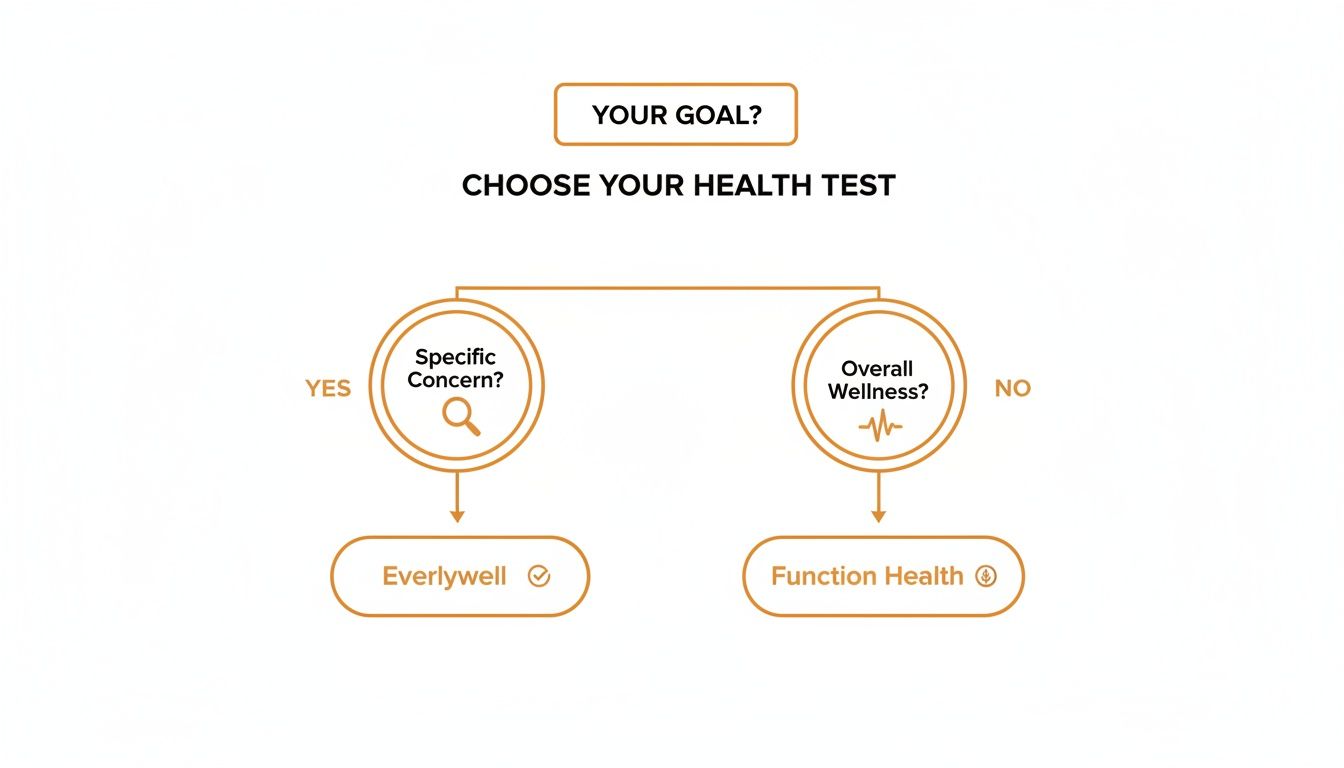
As you can see, your immediate health goal—whether it's solving a specific problem or pursuing overall wellness—is the biggest factor in deciding which service fits you best.
To help you quickly grasp their fundamental differences, here's a side-by-side comparison of Everlywell and Function Health's core features. This table cuts through the noise and highlights what truly sets them apart.
Ultimately, the Everlywell vs Function Health debate isn’t about picking a winner. It’s about matching the service to your personal health needs and goals, whether they're immediate or long-term.
Disclaimer: This article is for informational purposes only and is not a substitute for professional medical advice. Always consult a healthcare provider before making any lifestyle or medication changes.
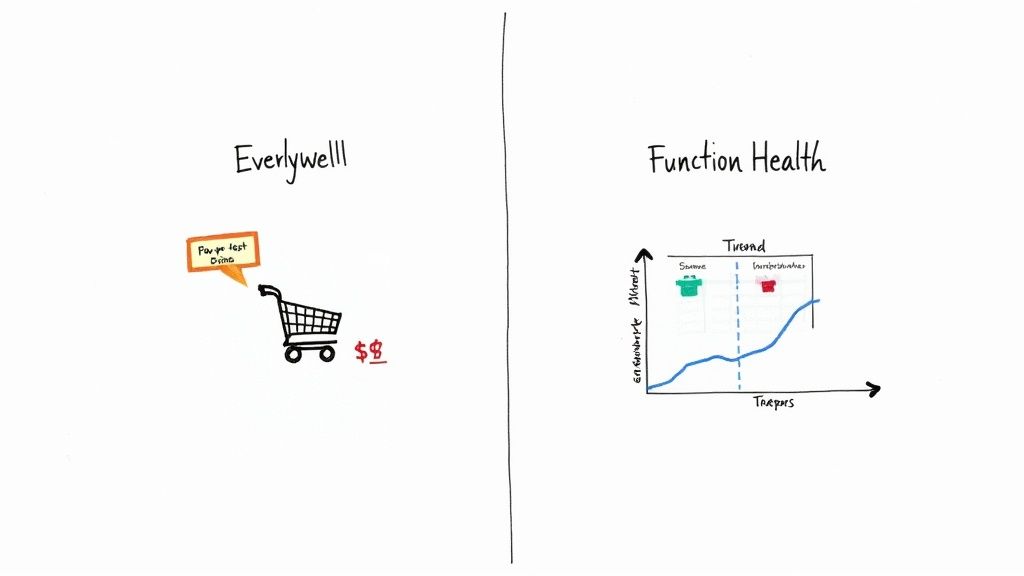
To really get to the heart of the Everlywell vs Function Health debate, you have to look past the menus of available tests. These companies aren't just selling lab work; they're offering two completely different ways to think about and manage your health. Applying some basic principles of comparative analysis helps clarify which one truly fits your goals.
Everlywell is built on a direct-to-consumer, transactional model. Think of it as the à la carte menu for health testing. You have a specific question—"Am I sensitive to gluten?" or "Are my Vitamin D levels low?"—and Everlywell sells a specific test to get you an answer.
This retail-style setup makes health testing incredibly straightforward. There are no memberships or long-term commitments. You just buy the test you need, when you need it, making it a great tool for reactive problem-solving.
Everlywell’s entire philosophy is about empowerment through immediate access. Their model is perfect for someone who's feeling a certain symptom or has a nagging health question and wants a quick, isolated answer without a fuss.
This business model thrives on flexibility. For instance, if you're battling fatigue, you might grab their Thyroid Test or Iron Test without needing to go through a comprehensive screening of biomarkers that don't seem related. It’s a focused, efficient way to investigate a single health concern.
Key Insight: Everlywell’s strength is its transactional nature. It’s designed for the person who wants to address a specific health question without the overhead of a full membership, offering a direct path from curiosity to a data point.
This approach is perfect for people who prefer to engage with health testing on an as-needed basis, giving them a clear and simple path to specific information.
Function Health goes in a completely different direction. Its core philosophy is all about proactive, continuous health optimization, and its subscription-based membership model reflects that.
Instead of one-off tests, Function Health positions itself as a long-term partner in your wellness journey. The whole idea is that health isn't a single snapshot in time but a dynamic story told through trends in your data. By analyzing over 100 biomarkers twice a year, it helps you see where your health is headed.
This approach is for someone who wants to shift from just reacting to problems to actively preventing them. The goal is to spot subtle changes long before they become serious health issues. For example, instead of just checking your cholesterol once, Function tracks it over time, letting you see exactly how your diet and lifestyle changes are impacting your cardiovascular risk.
Both of these models are well-positioned to succeed in the booming at-home health market. According to market analysis, the global at-home lab testing market is projected for significant growth in the coming years. With North America's consumer-direct channels leading the charge, both companies are tapping into a growing demand for accessible health data.
Ultimately, choosing between these two comes down to your personal health philosophy. Are you looking for a quick answer to a specific problem right now? Or are you ready to commit to building a long-term, data-driven understanding of your overall wellness? Your answer will point you straight to either Everlywell's targeted tests or Function Health's continuous monitoring system.
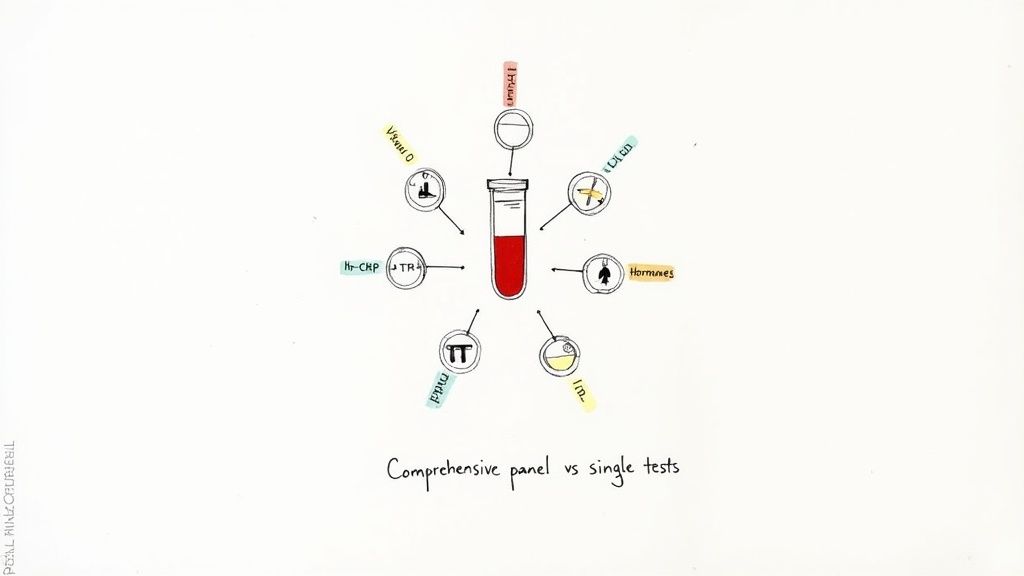
The real difference between Everlywell and Function Health shows up when you look at what they actually test. One gives you a menu of specific, targeted tests, while the other provides a sweeping, panoramic view of your health from the inside out. Which one is right for you really just depends on how deep you want to go.
Everlywell's approach is like using a magnifying glass. It lets you zero in on a single area of concern with a whole range of individual tests. It's built for targeted problem-solving.
For instance, if you're dealing with unexplained fatigue, you could grab their Thyroid Test or Vitamin D Test. If you're wondering about hormonal balance, you might go for their standalone Testosterone Test. This à la carte system puts you in control, letting you investigate specific symptoms without having to sign up for a broad, full-body analysis.
Everlywell’s menu is all about specificity. You pick a test based on a direct question you have about your health.
This method works great for getting a quick, isolated data point. According to the Mayo Clinic, hormones like testosterone affect everything from muscle function to mood, so a targeted test can give you valuable insight when a specific symptom pops up. But it’s just a snapshot, not the full motion picture of your health.
Scenario: You think your diet might be causing digestive issues. You could order Everlywell's Food Sensitivity Test to get a list of potential trigger foods. This gives you a direct, actionable piece of information tied to your specific concern.
This approach is cost-effective and efficient if your health question is narrow and well-defined. The catch is that it lacks the context of how that one biomarker interacts with the rest of your body's systems.
Function Health, on the other hand, uses a wide-angle lens. Instead of single tests, it provides comprehensive panels that analyze over 100 biomarkers in one go. The whole point is to give you a holistic understanding of your health, revealing connections between different systems that you’d otherwise miss.
Their standard panel covers a massive range of categories, giving you a deep, interconnected view of what’s happening inside your body. For a full breakdown, you can check out the complete Function Health biomarkers list and see just how extensive their analysis is.
This all-in-one approach covers key areas like:
Let's say you're focused on improving your heart health. With Everlywell, you could buy a Cholesterol and Lipids test. You'd get your LDL, HDL, and triglyceride numbers—useful information, for sure.
With Function Health, that same blood draw would not only give you those lipid numbers but also check your hs-CRP, ApoB, homocysteine, and dozens of other markers related to inflammation, metabolic function, and nutrient status. This broader context helps paint a much more complete picture. High LDL is concerning on its own, but seeing it alongside high inflammation and poor metabolic markers reveals a much more urgent and complex situation.
In short, the Everlywell vs Function Health choice comes down to your goal:
One provides a single answer, while the other starts a long-term conversation about your health, backed by a wealth of interconnected data.
Disclaimer: This article is for informational purposes only and is not a substitute for professional medical advice. Always consult with a qualified healthcare provider before making any changes to your health routine or treatment plan.
Getting a page of numbers is one thing; understanding what to do with them is something else entirely. This is where the real value in the Everlywell vs Function Health comparison starts to show—how each service helps you translate raw data into meaningful action.
Everlywell delivers your results through a clean, easy-to-read digital dashboard. They use simple indicators like "Normal," "Elevated," or "Low," so you can quickly see where you stand.
Each biomarker comes with a straightforward explanation of what it is and what a high or low value might mean. It's direct, digestible, and designed for quick understanding.
Everlywell’s approach is about delivering a specific answer to a specific question. If your test result falls outside the normal range, the platform generally recommends you follow up with your own doctor.
For more immediate support, Everlywell offers telehealth consultations, but these typically come at an extra cost. This option connects you with an independent, board-certified physician to go over your results and discuss what's next, turning your data into a more guided conversation.
This model works well because of its simplicity. However, it tends to present your health as a single snapshot in time, which can miss the broader context of your long-term health trends. Grasping the accuracy of these single-point tests is critical, something we dig into in our guide on Everlywell vs. Function Health accuracy.
Function Health takes a different route, weaving your individual results into a larger story about your health. Instead of just showing you a single data point, it shows how that number fits into your overall wellness picture by calculating a comprehensive health score.
This is powered by AI-driven insights that connect the dots between different biomarkers. For example, the platform might explain how your elevated LDL cholesterol—the "bad" kind—could be linked to signs of inflammation or metabolic stress found elsewhere in your panel.
The entire system is built around the idea of longitudinal tracking. By comparing your results over time, Function Health helps you spot trends, letting you see if your lifestyle adjustments are actually making a difference. Every member gets personalized recommendations from a clinician based on their unique results.
This approach turns raw data into a dynamic health story, showing where you’ve been and where you might be heading. For anyone who wants to dive even deeper into the research behind their results, learning how to read scientific papers effectively is an incredibly useful skill.
Key Takeaway: While both services provide valuable data, think of them as tools to inform—not replace—the essential relationship you have with your primary care provider. They empower you to have much more informed conversations about your health.
The contrast here is clear: Everlywell gives you a clean, static snapshot, while Function Health provides a dynamic, evolving analysis built for continuous optimization.
Everlywell has a significant footprint in the at-home testing market. Its strategy of offering a wide menu of à la carte tests, combined with acquisitions of lab and telehealth companies, has kept it highly visible as the sector has grown.
Ultimately, your choice boils down to the level of guidance you’re looking for. If you just need a straightforward answer to a specific concern and like having the option to pay for a consult, Everlywell is a solid choice. But if you want ongoing, integrated analysis that helps you track your progress over the long haul, Function Health’s model is built for that exact purpose.
When you get down to the brass tacks of Everlywell vs. Function Health, money and long-term value are often what tip the scales. The two companies couldn't be more different in their pricing philosophies, and that’s because they’re built for entirely different users. Unpacking their models makes the choice pretty clear, depending on whether you’re after a one-time answer or you’re in it for the long haul.
Everlywell’s pricing is as straightforward as it gets. You pay for each test as you go, with costs running from less than $50 for a simple vitamin check to several hundred for more complex panels. This à la carte approach gives you total flexibility to investigate a single health concern without getting roped into a recurring fee.
This pay-per-test structure is perfect for targeted diagnostics. If you've got a specific symptom and a hunch about the cause, Everlywell gives you a direct, affordable way to get that single piece of data.
The big win for Everlywell is its accessibility for one-off needs. You don’t have to sign up for a membership or commit to a bigger program just to get a simple question answered.
Here’s how that plays out in the real world:
For this kind of focused inquiry, Everlywell almost always wins on upfront cost. The catch? If you find yourself wanting to run several tests throughout the year, those individual costs can stack up fast, and you might end up paying more than you would for a comprehensive subscription.
Function Health is built on an annual membership model. For one yearly fee, you get two massive lab panels that cover over 100 biomarkers each, plus detailed reports and insights from clinicians. The initial sticker price is higher than a single Everlywell test, but its true value comes from the sheer breadth and frequency of testing.
This subscription-first approach has clearly resonated with people. The demand for bundled, proactive health tracking continues to grow, suggesting that many consumers see value in a comprehensive, ongoing service.
Key Insight: Function Health’s membership is designed for people who view their health as an ongoing project, not a one-time fix. The value isn’t just in the lab results; it’s in the power to track trends over time, see how different systems in your body are connected, and actually measure the impact of your diet and lifestyle changes.
Let’s make this concrete. Imagine someone who’s really focused on dialing in their metabolic and cardiovascular health.
With Everlywell, they might end up buying individual tests for:
Bought separately, these could easily run several hundred dollars. If they want to re-test in six months to see if their new diet is working, they’re paying that all over again.
With Function Health, all of those biomarkers—and dozens more—are baked into a single panel that’s included in the annual fee, which you get twice a year. For anyone committed to regular, deep-dive health screenings, Function Health's bundled subscription almost always comes out ahead financially in the long run. If you're leaning that way, it's worth seeing if Function Health has discounts to help manage that annual cost.
Ultimately, the right choice boils down to your goal: are you looking for a single answer right now, or do you want to start a continuous conversation with your body?
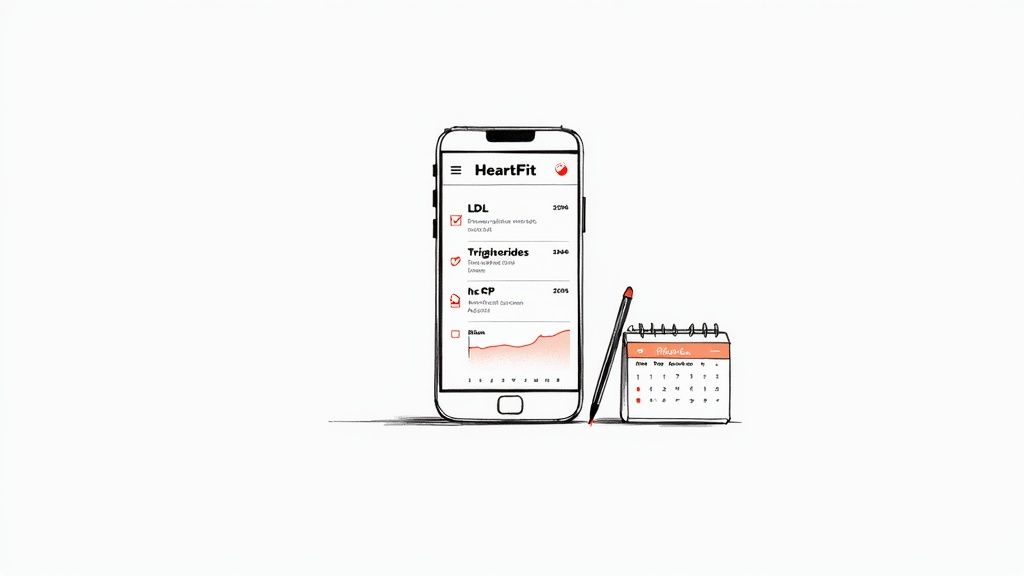
Getting that detailed report from Everlywell or Function Health feels like a huge step. But the data itself doesn't change anything—it's what you do with it that matters. Actionable data is only useful if you actually act on it. This is where we turn those numbers into daily habits, especially when it comes to your heart health.
Whether your Everlywell vs Function Health report flagged high LDL cholesterol, stubborn triglycerides, or simmering inflammation, the next move is the same. You have to connect those numbers to real-world choices. It’s one thing to know you need to make a change; it’s another thing entirely to stick with it day after day.
Without a solid system for tracking and accountability, even the best intentions fizzle out. This is where a good health tracking app becomes your secret weapon.
Think of the journey from a lab report to better health as needing a bridge. A health tracking app is that bridge, turning your doctor's or lab's clinical advice into a simple, manageable daily routine. The goal is to find a system that makes consistency feel easy, not like another chore.
For heart health, an app that hones in on nutrition and habit-building is a game-changer. Let's walk through exactly how you could use a platform like HeartFit (heartfit.ai) to get your plan rolling.
This step-by-step process takes abstract goals and turns them into concrete, bite-sized tasks.
Let's say your results came back with high LDL. Your action plan suggests more fiber, less saturated fat, and a healthy dose of omega-3s.
Key Takeaway: An app like HeartFit transforms a big clinical goal ("lower LDL") into a series of small, trackable daily wins ("eat a high-fiber breakfast"). This almost gamified approach builds momentum and makes healthy habits stick for good.
Here’s what that might look like in your tracking app:
By tracking these small but powerful actions, you create a direct, visible link between your daily choices and your long-term health markers. You can then watch your progress and see exactly how that consistency pays off in your next set of lab results.
At the end of the day, the best test is the one that actually motivates you to take consistent action. Whether you begin with a targeted test from Everlywell or a deep dive from Function Health, your very next step should be building a system that supports your journey to better health.
Disclaimer: This article is for informational purposes only and is not a substitute for professional medical advice. Always consult a healthcare provider before making any lifestyle or medication changes.
When you're diving into at-home lab testing, a few questions always pop up. Let's tackle the most common ones comparing Everlywell and Function Health so you can decide with confidence.
No. One of the biggest advantages of both Everlywell and Function Health is that they operate on a direct-to-consumer model. You can go straight to their websites and order the tests you need without getting a prescription or referral first.
That said, it’s absolutely critical to share your results with your doctor. These tests are meant to give you more information and work alongside traditional medical care, not replace it.
For monitoring your health trends long-term, Function Health is the clear choice. Its entire platform is designed around this very idea, providing two comprehensive panels each year to track how your biomarkers change. This is how you really see the impact of your lifestyle adjustments.
Everlywell's tests, on the other hand, are more like a single snapshot. They're great for investigating a specific, immediate concern but don't give you that continuous, longitudinal view of your health journey.
It depends. Everlywell is pretty good about accepting payments from Health Savings Accounts (HSA) and Flexible Spending Accounts (FSA) for most of its tests. Getting direct insurance coverage for either service is less likely, as is common with direct-to-consumer testing.
Function Health also notes that its membership might be eligible for HSA/FSA reimbursement. Your best bet is to always check with your specific plan administrator to confirm what’s covered before you buy.
A Quick Reality Check: As the National Institutes of Health (NIH) points out, while direct-to-consumer testing puts more health data in your hands, it’s vital that a healthcare professional helps interpret those results within the bigger picture of your overall health.
Getting the data is just the first step; turning it into action is what matters. Here are some of the best heart healthy apps for making sense of your results:
Ready to turn your health data into daily action? Heart Fit helps you build sustainable, heart-healthy habits based on your unique lab results. Start your free trial and create your personalized plan today at https://www.heartfit.ai.
Download HeartFit.ai and start your 66-day journey today.



Join the #hearthealth crowd who are leveling up their heart health with HeartFit.ai