Learn does function health test free and total testosterone, what it measures, accuracy, costs, and how to interpret results.

Yes, Function Health's standard panels do include tests for both total and free testosterone. Understanding this is crucial because it allows us to explore what these numbers truly signify for your health.
This article is for informational purposes only and is not a substitute for professional medical advice. Always consult a healthcare provider before making any changes to your lifestyle or health regimen.
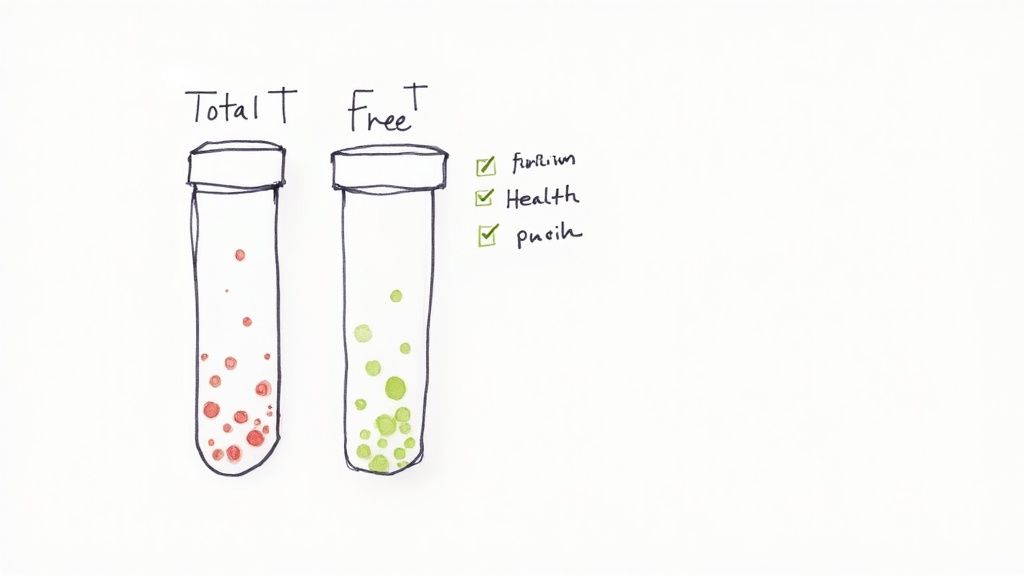
When assessing hormones, a single number rarely provides a complete picture. Measuring both total and free testosterone is necessary to gain a clear understanding of your body's hormonal status.
Think of total testosterone as the entire supply of testosterone in your bloodstream. This measurement includes testosterone that is "bound" to proteins, rendering it unavailable for immediate use by your cells.
On the other hand, free testosterone is the portion that is unattached and readily available for your body to use. This is the biologically active form that directly influences functions like energy levels, muscle mass, and libido. According to the National Institutes of Health (NIH), this bioavailable hormone is what interacts with cell receptors to exert its effects.
Let's use a simple analogy: think of total testosterone as all the cars in a large city. Free testosterone represents the available taxis, ready to pick up a passenger at a moment's notice. One figure gives you the overall supply, while the other shows what's actually available to perform a function.
This table provides a quick summary of their distinct roles.
Obtaining both of these measurements from your Function Health panel is the first step. The next is to interpret them with a healthcare professional to determine appropriate actions based on your results.
In short, both total and free testosterone are needed for a full hormonal assessment because total testosterone shows overall production, while free testosterone shows what your body can actually use.

Let's begin with total testosterone. This figure represents the entire amount of testosterone circulating in your bloodstream, providing a high-level snapshot of your body's overall hormone production.
However, not all of this testosterone is available for use. The majority is "bound" or attached to two main types of proteins:
Your total testosterone level is the sum of all three forms: testosterone bound to SHBG, testosterone bound to albumin, and the small amount that is completely unbound, or "free."
Defining a "normal" level is complex, as it is not a single number. The Centers for Disease Control and Prevention (CDC) states that reference ranges vary significantly based on age, the time of day blood was drawn, and the specific laboratory conducting the analysis.
Your total testosterone provides a foundational number, a starting point for a deeper conversation with your healthcare provider about your health.
For instance, a 2017 study on hormonal reference ranges published in The Journal of Clinical Endocrinology & Metabolism found that healthy, non-obese men aged 19 to 39 have a total testosterone range of 264 to 916 ng/dL. This highlights how ranges can differ based on demographic factors.
While total testosterone is a critical piece of the puzzle, it doesn't reveal the full story. To understand what is functionally available to your body, we must also examine free testosterone.
Disclaimer: This article is for informational purposes only. It is not a substitute for professional medical advice. Always consult a healthcare provider for any health concerns or before making changes to your lifestyle or treatment plan.
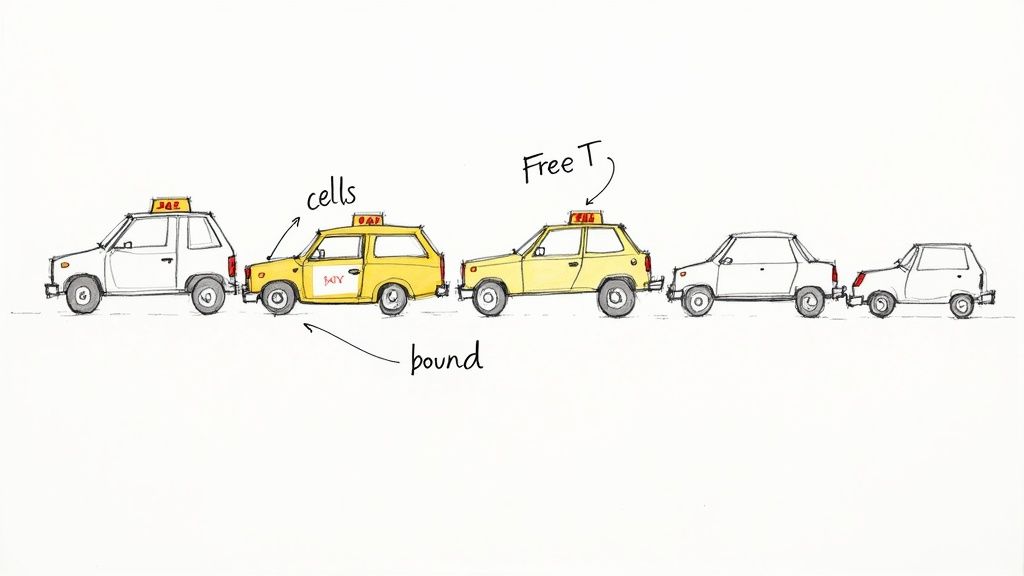
If total testosterone is all the cars in a city, free testosterone is the fleet of available taxis—ready to get to work immediately. This is the bioavailable hormone that can enter your cells and initiate physiological processes.
Free testosterone is the unbound, active form of the hormone that directly influences critical functions, including building muscle mass, maintaining bone density, regulating mood, and supporting libido. It is the key that unlocks cellular receptors to perform these tasks.
A key protein, Sex Hormone-Binding Globulin (SHBG), determines how much free testosterone is available. SHBG binds tightly to testosterone, effectively taking it out of circulation.
As individuals age, SHBG levels often increase, which means more testosterone becomes bound and inactive. Consequently, a person's total testosterone level might appear normal on a lab report, while the amount of usable free testosterone could be low. This demonstrates why evaluating total testosterone alone can be misleading.
A person can have a "normal" total testosterone level on a lab report but still experience symptoms of low testosterone, such as fatigue and low sex drive. This often occurs when high SHBG levels result in low levels of active, free testosterone.
This is precisely why a free testosterone measurement is vital for a complete and accurate health assessment. Research indicates that free testosterone can be a more sensitive marker for androgen deficiency. You can find more information about free testosterone's diagnostic value here.
Ultimately, when you ask does Function Health test free and total testosterone, you are asking if it provides both the broad overview and the specific, actionable details. The free testosterone measurement offers the crucial insights needed to truly understand your hormonal health.
The process of getting your hormones checked through Function Health is designed to be direct and efficient. The company partners with Quest Diagnostics, a major laboratory services provider, to facilitate testing. After signing up and completing an online intake form, you will visit a local Quest Diagnostics lab for a blood draw. A physician's order is not required to access the panel.
This model provides direct access to high-quality testing. Your sample is analyzed using sophisticated methods like immunoassays or Liquid Chromatography-Mass Spectrometry (LC-MS), which are considered industry standards for achieving precise and reliable hormone level measurements.
Within the Function Health platform, you can review your selected panel to confirm every biomarker that will be tested. This transparency is important, as you'll want to ensure both free and total testosterone are included for a comprehensive hormonal health analysis.
While total testosterone has historically been the primary focus, it is now understood that free testosterone provides critical information. Free testosterone typically represents only 1% to 2% of the total amount.
To illustrate, a male between 40 and 49 might have a total testosterone level between 252 to 916 ng/dL. His free testosterone, however, would fall within a much smaller range, from 5.3 to 26.3 ng/dL. You can explore more data on typical testosterone levels on Hone Health's site.
By measuring both, Function Health provides a richer dataset. It's one thing to know how much testosterone your body is producing, and another to know how much is actually available to perform its functions.
For those interested in the technical aspects of different testing services, our guide comparing Function Health vs. Everlywell accuracy offers a detailed breakdown. After receiving your results, the next step is interpretation.
Receiving a lab report can be overwhelming. Your free and total testosterone results will be listed alongside "reference ranges," which represent the typical values for a general population. However, "normal" is not necessarily "optimal," and these ranges are not universally applicable.
Ideal levels vary based on factors like age, overall health, and even the time of day your blood was drawn, a point often highlighted by reputable sources like the Mayo Clinic. These numbers should be viewed as a starting point for a conversation with a healthcare professional.
The testing process is designed for simplicity, from ordering the kit to viewing your results online.

Function Health facilitates the journey from curiosity to clarity, placing valuable health metrics at your disposal.
While Function Health provides the raw data, translating that data into an actionable plan requires professional expertise. It is essential to review these results with a doctor or another qualified healthcare provider. They can interpret your numbers within the context of your personal health history, symptoms, and wellness goals.
Important Disclaimer: This article is for informational purposes only and is not a substitute for professional medical advice, diagnosis, or treatment. Always seek the advice of your physician or another qualified health provider with any questions you may have regarding a medical condition.
Attempting to self-diagnose based on a lab report can lead to confusion and anxiety. A medical professional can determine if your levels are appropriate for you and recommend the next steps, if necessary. This collaborative approach is key to turning data into genuine health improvements. For more details on the service, you can read our full review on whether Function Health blood testing is worth it.
After reviewing your Function Health results for free and total testosterone with your doctor, the focus shifts to implementation. The next step involves translating this data into consistent, daily habits.
Building a lifestyle that supports healthy hormone balance does not require a complete life overhaul. It is about making small, sustainable choices. Evidence-based strategies often focus on core areas such as resistance training, stress management, and obtaining adequate sleep. Additionally, targeted nutrition plays a significant role. For example, the American Heart Association recommends a diet rich in whole foods, lean proteins, and healthy fats as a foundation for overall wellness, which includes hormonal health.
Bridging the gap between knowing what to do and doing it can be challenging. A dedicated habit-tracking application can be a valuable tool in this process. Here are some options:
The goal is progress, not perfection. Consistent, small, positive choices are more effective than attempting a massive, unsustainable lifestyle change.
By leveraging technology to guide your daily routine, you can translate your lab results into meaningful, long-term health improvements.
Disclaimer: Always consult with your healthcare provider before beginning any new health, diet, or exercise regimen. This article is for informational purposes only.
Here are answers to some of the most frequently asked questions about testosterone testing.
While this article focuses on testosterone, many people tracking their overall health also monitor their heart rate. A normal resting heart rate for most adults ranges from 60 to 100 beats per minute (BPM), according to the American Heart Association. Factors like fitness level, age, and stress can influence this number. It's best to discuss your specific heart rate with your healthcare provider.
There is no single answer, as testing frequency is highly individualized. The American Urological Association suggests that the appropriate interval depends on your age, symptoms, and overall health. Your doctor is the best person to determine a testing schedule for you. For some, an annual test is sufficient, while others, particularly those undergoing treatment, may require more frequent monitoring.
Timing is crucial for an accurate reading. Testosterone levels are naturally highest in the morning and decline throughout the day. For this reason, medical professionals recommend having your blood drawn early, typically between 7 AM and 10 AM. Testing later in the day may result in an artificially low reading, which would not provide a true baseline.
No, this is an important distinction. Function Health provides laboratory data, but it does not offer medical diagnoses. A formal diagnosis for a condition like hypogonadism (the clinical term for low testosterone) must be made by a qualified healthcare provider. Your lab results are a critical piece of the puzzle, but a doctor will consider them alongside your symptoms, medical history, and a physical examination to make an accurate diagnosis. Other factors, like cortisol levels, can also influence testosterone, which is why a comprehensive medical evaluation is essential. You can learn more in our guide on whether Function Health tests cortisol levels.
Ready to stop guessing and start building a healthier life? Heart Fit translates your lab data into a simple, personalized action plan you can actually follow. Take your results and turn them into sustainable daily habits. Start your free trial today.
https://www.heartfit.ai
Download HeartFit.ai and start your 66-day journey today.



Join the #hearthealth crowd who are leveling up their heart health with HeartFit.ai